

Making Knowledge Public: A Letter from the Editor
Thurka Sangaramoorthy is the Editor-in-Chief of Semi-Structured and the Founder and Director the Public Ethnography Lab. She is a cultural and medical anthropologist and global health researcher with expertise in community-engaged ethnographic research, including rapid assessments, among vulnerable populations in the United States, Africa, and Latin America/Caribbean. She conducts research in the areas of global health and migration, HIV/STD, and environmental health disparities. Dr. Sangaramoorthy is the author of numerous publications including three books. Currently, she is Professor and Chair of the Department of Anthropology at American University and Affiliate Professor at Addis Ababa University in Ethiopia.
Elise Ferrer is the Managing Editor of Semi-Structured and the Lab Manager of the Public Ethnography Lab. She completed her MA in Public Anthropology at American University in 2024 and joined PEL immediately thereafter. She also serves as the Conference Manager for the annual Public Anthropology Conference. Her scholarly work explores race, labor, space, and historiography, grounded in a commitment to producing politically accountable research legible within and beyond anthropology. She has published in American Anthropologist, Social Science & Medicine and the American Journal of Public Health.
What gets remembered? Walking through Greenpoint, Brooklyn in the cold early days of 2025, Paul Odér carried this question down streets lined with luxury apartments, industrial depots, past shiny new businesses whose branding referenced the very toxic companies upon which the storefronts were built. His question was not rhetorical. It was methodological — an inquiry into how environmental harm disappears from public memory even as it continues to shape the bodies and lives of those most impacted by it.
The question haunts every piece in this collection. Making knowledge public is rarely as straightforward as it sounds. It is not simply a matter of translation — of converting findings into accessible language and releasing them into the world. It is a set of choices, costs, and negotiations, each shaped by the question of whose knowledge, made public for whom, at what price. And it assumes a public — singular, waiting, ready to receive — that does not exist. There are only publics: multiple, uneven, often in conflict, shaped by different histories of what has been remembered and what has been allowed to disappear.
We want to be honest about the tension in this issue’s title. "Making knowledge public" can sound like a delivery problem — a matter of converting findings into accessible language and releasing them toward waiting audiences. The seven pieces in this collection, taken together, reject that framing. What they document is not a failure of communication but a set of structural questions about knowledge and power. Public anthropology cannot begin at the end of the research process. It has to be woven through the very conditions under which knowledge is made — present at every stage, attentive to how knowledge moves, who it reaches, what relationships it depends on, and how it responds to the questions and needs of the people whose lives are at stake.
This is the second issue of Semi-Structured. Where our inaugural issue, “Ethnography in Action,” asked what ethnography looks like when it moves into the world, this issue asks what happens when it gets there: who controls how knowledge circulates, what becomes visible and what gets erased, and who bears the cost of insisting on what the record should say.
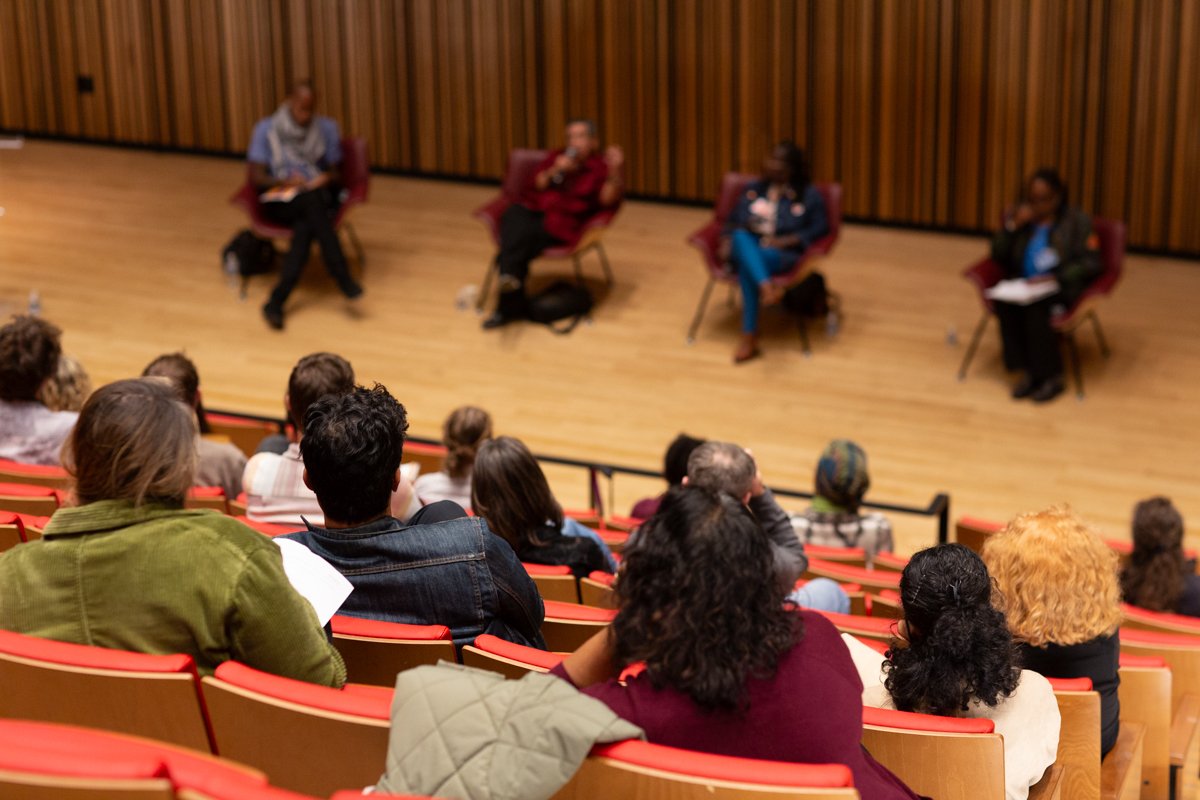
The keynote panel at the 2025 Public Anthropology Conference, hosted by the Department of Anthropology at American University and situated as a major project of PEL. The conference sought to actualize the ethics and sensibilities represented in this issue.
At What Cost?
Two pieces in this issue take the question of cost with particular directness. In "A Damage-Control Photographer’s Counter-Archive,” Banerjee writes from inside an assignment they could not in good conscience complete as requested. Commissioned to photograph one of India’s largest textile factories for public relations purposes, they produced two sets of images: a polished set for the client and a counter-archive documenting what the commission was designed to hide. The diptych series that emerged — color images of handloom weavers in Pochampally alongside black-and-white images of the factory floor — became, in Banerjee’s account, an ethnographic methodology in its own right: placing two worlds side by side, refusing invisibility, transferring the ethical obligation of witnessing onto the viewer. “My complicity on the factory floor,” Banerjee writes, “became its own form of evidence.” That the counter-archive now sits quietly in a corner of a website — a whistle-blower in plain sight — is both the piece’s resolution and its unresolved question.
Jean-Yves Taranger’s photo essay “Performing for the State” documents a different kind of cost: the price a Mixtec community in Oaxaca paid to have its textile heritage legally protected. Invited to document the filming of a government-sponsored video intended to support a cultural heritage decree, Taranger watched as a film director scripted Don Melchor, a community historian of extraordinary depth, to speak lines locating the community’s living, transmissible, relational knowledge in blood. The irony Taranger identifies is precise: a decree designed to protect knowledge that must be learned and taught was introduced by a script that made it sound like something inherited. “To be recognised,” Taranger writes, “the community had to become legible to the state — and in doing so, was only partially recognised by it.” The decree passed. The community won. And something was lost in the winning.
What Gets Remembered, What Gets Erased
Paul Odér’s “What Gets Remembered?” pursues its question through four walks in Greenpoint, triangulated with an archival analysis of development documents and a walking interview with Cole, a fourth-generation Greenpoint resident and environmental justice organizer. What Odér finds is that gentrification does not reduce or eliminate childhood lead poisoning. It obscures it through the selective memory of official records and developer-state arrangements that bury contaminated soil under luxury foundations rather than remove it. By the essay’s end, “what gets remembered?” has become a question about public health, institutional accountability, and who gets to decide what the neighborhood’s story is.
Nikita Jawa’s “What the System Sees as Parental Engagement — And What It Misses” works a related seam from a different direction. Conducting fieldwork on parental engagement in tribal residential schools in Odisha, Jawa found herself participating in the very process of erasure she was documenting. As field observations moved through the stages of analysis, coding, and policy reporting, a parent’s layered account of effort, hesitation, and exclusion became the category “low awareness.” What was expressed as “we are not seen” became “parents need more awareness.” The piece is an unflinching account of how ethnographic knowledge gets compressed in its institutional journey and what it means to recognize your own complicity in that compression.
Knowing Otherwise
Sangeeta Jawla’s “Making, Narrating, Knowing” insists on forms of knowledge that resist institutional capture. In the piece, Jawla approaches this question from inside a tradition of craft knowledge that academic institutions have rarely known how to value. A potter, researcher, and performer from a family of potters in Haryana, Jawla’s methodology is itself a form of making knowledge public: pottery sessions, storytelling workshops, and performances in which knowledge moves through touch, gesture, and material practice rather than through written argument. The Chameli narrative at the piece’s center — the story of a woman who could prepare the clay, decorate the vessel, and carry the water, but who was not permitted to touch the wheel — does more in two sentences than any policy recommendation could do in 20 pages.
The Architecture of Knowing
Two pieces offer the collection’s most direct examinations of what it means to design a process for making knowledge public. Asma Mehan's “That Is Not What This Place Is to Us” opens on an early morning meeting at an abandoned cotton gin in rural Texas. Leading a community design studio at Texas Tech through a participatory adaptive reuse process with residents of a small West Texas farming community, Mehan found the project’s methodological reframing in a single sentence: a community member studying a watercolor rendering of the old cotton gin looked up and said, “That is not what this place is to us.” The sentence named a gap between knowing a place and knowing about it. The rest of the project became an attempt to close it — through sensory mapping sessions, walking interviews, and a commitment to crediting community knowledge as intellectual labor. Mehan’s piece is the collection’s most explicit meditation on accountability as method: what it means to be responsible not just for what you find, but for how you structured the conditions of finding it.
Prarthana Mitra’s “Bodies of Evidence” offers an extensive narration on building a game-based toolkit to counter online gender-based violence and disinformation through a Global South, feminist framing. Mitra describes how creating the toolkit wasn’t a simple process. If the toolkit was an answer to a set of problems – and conventional problem statements didn’t capture the realities of their communities – then the toolkit required a “radical reimagination of the conventional problem statements related to digital safety and misinformation,” one which feminist methodologies and movements have long actualized. Putting this into practice, the toolkit emerged through deep relations both with international, feminist “para-ethnographers” – who are developing interventions for gendered disinformation in their local contexts – and with feminist lawyers, journalists, and activists in India. Ultimately, the toolkit became a deliverable, process, and archive of feminist care, knowledge, and action.
On the Labor of This Issue
We want to say something about how this issue was made because the process of editing these seven pieces was itself a form of making knowledge public, and it was not without its tensions.
Each piece arrived carrying years of expertise. Each arrived, too, with habits of form shaped by the academic and professional contexts from which it came — section headers that gave the writing a policy report feel, theoretical scaffolding that held the argument at arm’s length from the fieldwork, citation densities calibrated to academic audiences rather than general readers.
Our editorial work was not simply a work of translation — a word that implies something already complete being carried across a border. It was slower and more relational than that: a process of asking authors to trust their fieldwork more than their analytical scaffolding, to begin in the room rather than with the research question, to name their stakes rather than bracket them. What we were working toward, in each manuscript and across the issue as a whole, was not accessibility as an endpoint but what we have come to call ethnographic sensibility — the orientation that makes anthropological insight available not because it has been simplified but because it has been honestly situated. Skills can be taught in a workshop; sensibility develops through sustained engagement, reflection, and the willingness to be changed by the people and places you are working with. These pieces, and the exchanges that shaped them, are evidence of that process.
This work was iterative and sometimes uncomfortable for authors and editors alike. What you are reading is not a first draft. It is a collaborative production, shaped across multiple rounds of exchange, and the knowledge it makes public has been made more public through the making — more accessible, more felt, more honest.
Looking Forward
The pieces in this issue are not optimistic in any simple sense. Gentrification obscures lead poisoning. State recognition compresses living knowledge into legal categories. Policy reports flatten what fieldwork took months to hear. These are not failures of individual researchers or institutions — they are structural conditions that anyone working at the intersection of knowledge and power will encounter.
What these pieces offer is not resolution but a way of staying with the problem.
At what cost?
For whom?
What gets remembered?
Whose needs and desires shape what we pass forward?
These are not questions with single answers. But they are the right questions. The willingness to keep asking them, in public, in specific places, with specific people, is what public ethnography is for.
The goal, as we have come to understand it, is not to bring knowledge to the public. It is to excavate where knowledge is already being made — in the pottery household, on the factory floor, in the walking interview, in the room where parents finally get to speak — and to create the conditions under which that making can be seen, heard, and taken seriously. That is what these seven pieces do. That is what we are trying to build.
We are grateful to the communities, interlocutors, and collaborators whose knowledge animates every piece in this collection. We are grateful to the authors who trusted us with their work.
Thank you to our collaborators on the 2025 Public Anthropology Conference: Core Team (Dr. Alanna Warner-Smith and Jean Wogaman), Student Fellows (Katharine Grace McCartha, Kaitlyn Rice, Catherine Comerford, and Haley Armstrong), the Advisory Board, and AU Anthropology community. Our collective insights, collaboration, and praxis during the conference deeply shaped this issue. Thank you to the PEL Interns (Asher Rosen, Claire Hoernemann, Emily DeMaio, and Oscar Ellery), whose discernment and labor helped bring this issue to life.
And we are grateful to our readers for joining this ongoing conversation about what it means and what it costs to make knowledge matter.
Thurka Sangaramoorthy
Editor-in-Chief, Semi-Structured
Elise Ferrer
Managing Editor
Public Ethnography Lab
June 2026