

More than Disembodied Stories: Seeing the Human Experience Behind Migration
About the Author: Kelly Nilan worked with the University of Denver’s Courtwatch team while pursuing her master's in public policy from 2024 – 2025. She started working on this project in Dr. Rebecca Galemba’s Qualitative Research Methods course where she began her research on the Family Expedited Removal Management (FERM) program. After the course concluded, she stayed on the Courtwatch team to continue the research, using the findings to help support the Courtwatch team’s existing research and inform her public policy capstone memo and presentation.
Abstract: Migrants are often reduced to policy categories and legal outcomes rather than understood as people navigating difficult circumstances and trying to improve their lives. This essay reflects on my experience meeting a family in the Family Expedited Removal Management (FERM) program to explore the importance of empathy and humanization in conversations about immigration and justice.
Author’s note: To ensure privacy, pseudonyms have been used in place of participant names.
Keywords: FERM; families; asylum
Citation: Nilan, Kelly. 2026. “Echoes of Separation: From Childhood Trauma to Courtroom Advocacy.” Semi-Structured (Washington, D.C.), On Ethnographic Witnessing: Student Encounters with Immigration Court, vol. 1 (3). https://doi.org/10.57912/34112502
In early 2024, I was working on a group research project at the University of Denver focused on the Family Expedited Removal Management (FERM) program, implemented in May 2023 under the Biden Administration. FERM applied to families apprehended at the southern U.S. border without an appointment through CBP One, a glitchy mobile app that migrants could, theoretically, use to schedule appointments for asylum claims. Appointments could only be made in Mexico, meaning families would have to arrive there first to schedule and would be stuck there while waiting for an appointment.
Families in FERM underwent an expedited screening process that decided whether their fear of returning to their country of origin was “credible” enough to pursue an asylum claim. While in the program, a head of household would be required to wear an ankle monitor, abide by a curfew and upload selfies to the CBP One app.
We began this research because, when the program was implemented, it was not widely advertised, with only two official uploads to the U.S. Immigration and Customs Enforcement (ICE) website, and the information provided was vague.
Initially, we wanted to understand FERM’s impact on families and attorneys in Denver, focusing on selection criteria and whether the expedited timeline allowed adequate case preparation or representation. However, as we began collecting interviews, we found many Denver immigration attorneys had not even heard of FERM, so we expanded our focus nationwide.
Prior to this project, we had an existing collaboration with a pro bono immigration legal services organization. When the organization learned about this program, they requested the immigration court send them lists of the families enrolled. Through this process, they learned of a family in FERM that had a Negative Credible Fear Review (NCFR) scheduled in just two days. Despite the immediate timeline and an already overwhelming caseload, Amy (pseudonym), an attorney for the organization, took on their case and asked my group if we wanted to attend the review.
The NCFR is an immigration judge’s review of a negative Credible Fear Interview (CFI) finding made by an asylum officer (AO). The AO decides the CFI outcome based on whether they believe the family has a “significant possibility” of enduring persecution or torture if returned to their country of origin. This interview takes place 6-12 days after the family arrives. If it is positive, the family enters regular immigration removal proceedings, during which time they can apply for available forms of relief. However, if it is negative, the family may request an NCFR before an immigration judge, scheduled just 1-7 days later.
This timeline leaves limited time to access resources that could help families with their case, impeding their right to due process. Additionally, many families travel long distances, at high costs, for these interviews. Americans for Immigrant (AI) Justice, a non-profit organization that advocates for migrant rights and provides free legal services, reported that some families they worked with had to pay upward of $200 - $300 in taxi fares to appear at their CFI.
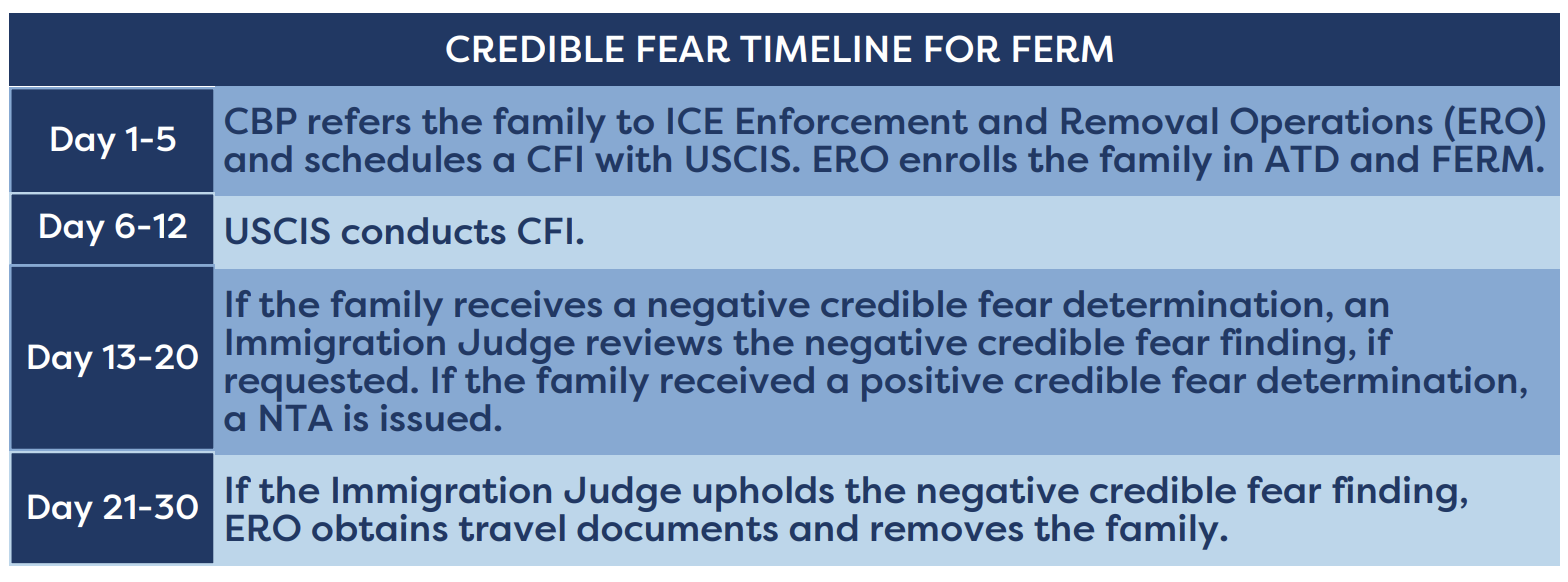
Figure 1. A full timeline of the FERM process produced by AI Justice. Woods, Cindy S. Issue brief. Family Expedited Removal Management Program (FERM): A Three Month Assessment, September 2023. https://aijustice.org/wp-content/uploads/2023/08/FERM-Report-FINAL.pdf.
When we arrived at the courthouse, a line wrapped around the lobby as families waited to check in. We saw Amy enter, quickly scanning her badge to pass through security.
Once in the courtroom lobby, the energy felt chaotic. A single security officer directed numerous families, while others spilled out of overcrowded courtrooms. With no designated waiting areas for families, parents stood in hallways with crying children.
We connected with Amy and the family, a mother, Sonia (pseudonym), and her child.
Amy spoke with Sonia before her hearing, asking how she felt going into the NCFR. Sonia seemed unprepared, prompting Amy to recommend that she request a continuance (more time) from the judge so Amy could help prepare her. Sonia was hesitant; she had just fled Colombia seeking safety only to be thrown into a program that forced her to be under constant surveillance and attend various appointments within days of arrival while securing her family’s everyday needs. She was exhausted and just wanted it to be over.
Amy knew how important her guidance would be for their case and persuaded Sonia to accept her help. Amy requested a continuance from the judge, which was granted, and she guided us to a windowless office with a few chairs and a small desk.
Before we entered, Amy asked Sonia whether she would be okay with us sitting in the room with them. She agreed. As a white American citizen, my privilege was palpable. I felt uncomfortable asking to sit in on such a vulnerable conversation and wondered if they felt pressured to say yes to Amy.
We entered the room; my team and I sat in the corner, Amy at the desk, and Sonia and her daughter behind Amy.
Amy began asking Sonia questions in Spanish that I could not understand. She answered with a tired smile, while her daughter sat quietly by her side, occasionally fidgeting and shifting in the hard plastic chair.
Once the conversation ended, Amy scheduled a time to talk with Sonia one-on-one to prep her further, which my team was briefed on afterward.
Amy told us that Sonia’s CFI occurred over the phone with her daughter present. She had to recount her traumatic experience of witnessing her family member being killed by the National Liberation Army (ELN) in an attempt to save her life. We also learned that she was being persecuted as a member of the LGBT+ community and that her partner was taken by the ELN - never to be seen again. She omitted this detail in the CFI because her daughter did not know, and she felt uncomfortable sharing it in front of her.
This omission was crucial to her case as persecution based on sexuality is a qualification to apply for asylum - a fact she would have known if she had been able to access counsel before her CFI.
The day of Sonia’s NCFR, Amy helped arrange accommodations for her daughter so she would be more comfortable sharing the full details of her experience. She told her story, and the judge vacated the negative decision, allowing her to remain in the U.S to apply for asylum.
This suggests that if Amy was unable to coach her before her NCFR, she likely would have omitted the same information and been removed from the U.S. This was sadly the case for many individuals in FERM, with a majority of those who were unable to receive counsel or pro se prep having their negative decisions affirmed by an immigration judge, resulting in their removal (see figure 2).
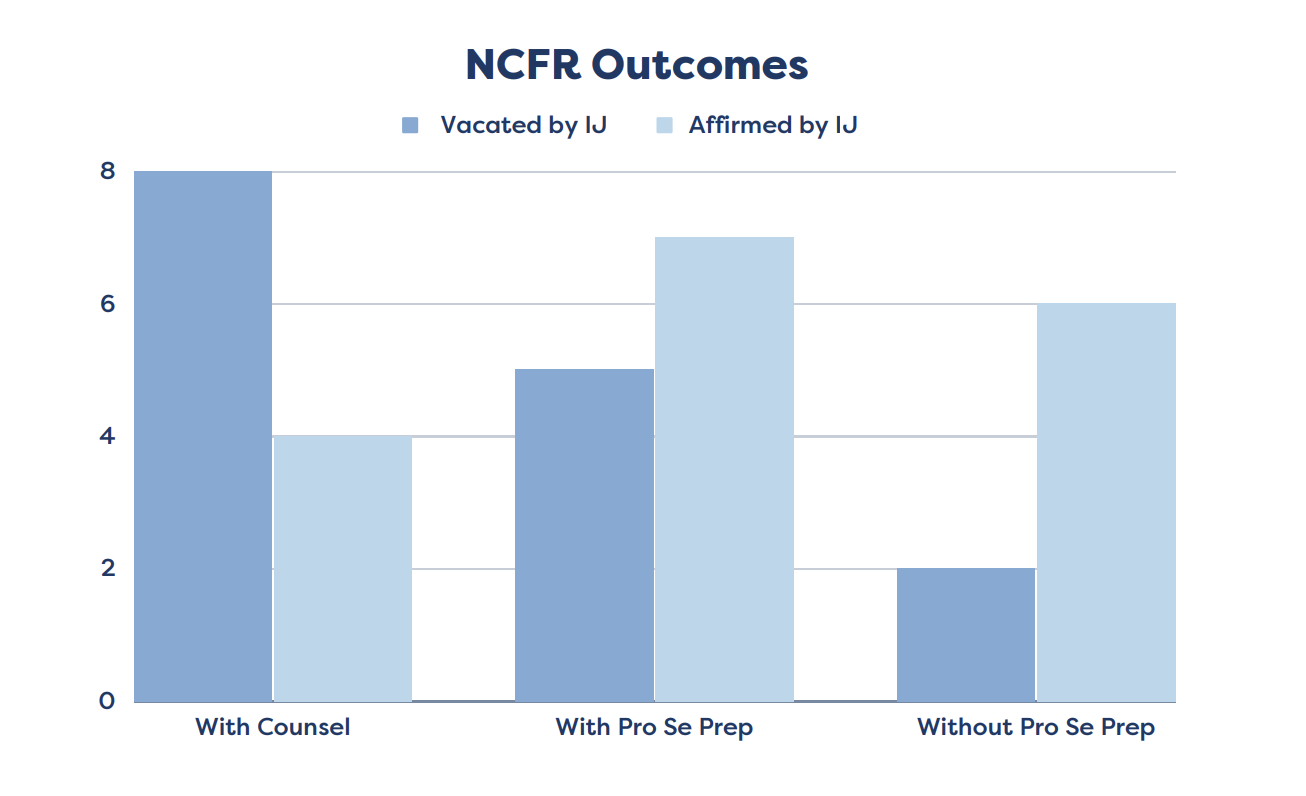
Figure 2. A graph of NCFR outcomes produced by data collected by AI Justice. Woods, Cindy S. Issue brief. Family Expedited Removal Management Program (FERM): A Three Month Assessment, September 2023. https://aijustice.org/wp-content/uploads/2023/08/FERM-Report-FINAL.pdf.
This experience produced complicated feelings for me. I was relieved and excited to hear the results. I had not heard the outcome of the NCFR until months later due to Amy’s busy schedule and thought I may never find out. I felt a connection to this family who I had not even spoken to aside from a greeting and thank you. From my research, I already knew this program was unjust and needed reform, but connecting a face to the story made the consequences feel more real. Knowing that most families in FERM faced similar circumstances made learning about the instances where the immigration judge affirmed the negative CFI decision even more difficult. I couldn’t help but picture the family I had met and the real threat of violence and persecution that would have awaited them if they had been removed from the U.S.
I realize most people will never attend immigration court to observe or meet the families impacted by programs like FERM. However, what I witnessed made it clear that immigration cases are more than just disembodied stories of legal outcomes; they are decisions that can permanently shape people’s lives. Centering the human experience of migrants reveals what is truly at stake and encourages a more empathetic understanding of immigration and the challenges created by the systems that govern it.
References
Woods, Cindy S. Issue brief. Family Expedited Removal Management Program (FERM): A Three Month Assessment, September 2023. https://aijustice.org/wp-content/uploads/2023/08/FERM-Report-FINAL.pdf.
About the issue
This article is part of On Ethnographic Witnessing: Student Encounters with Immigration Court, a special issue of Semi-Structured. This collection features the work of 22 student ethnographers, who offer insights, analysis, and experiences based on hundreds of hours in immigration courtrooms across the country over the last few years. Through their work in observation projects under the direction of scholar-activists Lauren Heidbrink, Amelia Frank-Vitale, and Rebecca Galemba, students gained critical training in ethnographic practice and a crash course in immigration law, especially in the disjunctures between law on the books and law in practice. Understanding that wider audiences would benefit from hearing and learning directly from their students, Heidbrink, Frank-Vitale, and Galemba approached Semi-Structured to steward this thoughtful, ambitious collection. We are honored to run this issue and invite readers to consider what student observers witnessed, felt, and learned in court and why ethnographic observations are important to broader publics.
Semi-Structured is the open-access journal from the Public Ethnography Lab. The journal is dedicated to showcasing ethnography as it unfolds in the world. This journal exists because we believe ethnographic work matters beyond the academy—that the insights generated through sustained engagement with communities, organizations, and institutions can and should inform decisions, shape practices, and drive meaningful change.