

Mundane Absurdities: Theatrical Abstraction and Embodying the Unseen (A Performance)
About the Author: Amelia Wray is a member of Princeton University’s Class of 2028, majoring in Anthropology with minors in Latin American Studies, History, and Music Performance. Her ongoing work in legal advocacy and research surrounding immigration inspired her participation in the Justice In View ethnographic court-watching project under the mentorship of Dr. Amelia Frank-Vitale, from which this piece emerged.
Abstract: What can a flower stand or a deli counter translate about immigration court?
Keywords: Bureaucracy, embodiment, waiting
Citation
Wray, Amelia. 2026. “Mundane Absurdities: Theatrical Abstraction and Embodying the Unseen.” Semi-Structured (Washington, D.C.), On Ethnographic Witnessing: Student Encounters with Immigration Court, vol. 1 (3). https://doi.org/10.57912/34070523
Access link: www.publicethnography.com/semi-structured-all-issues/issue-3
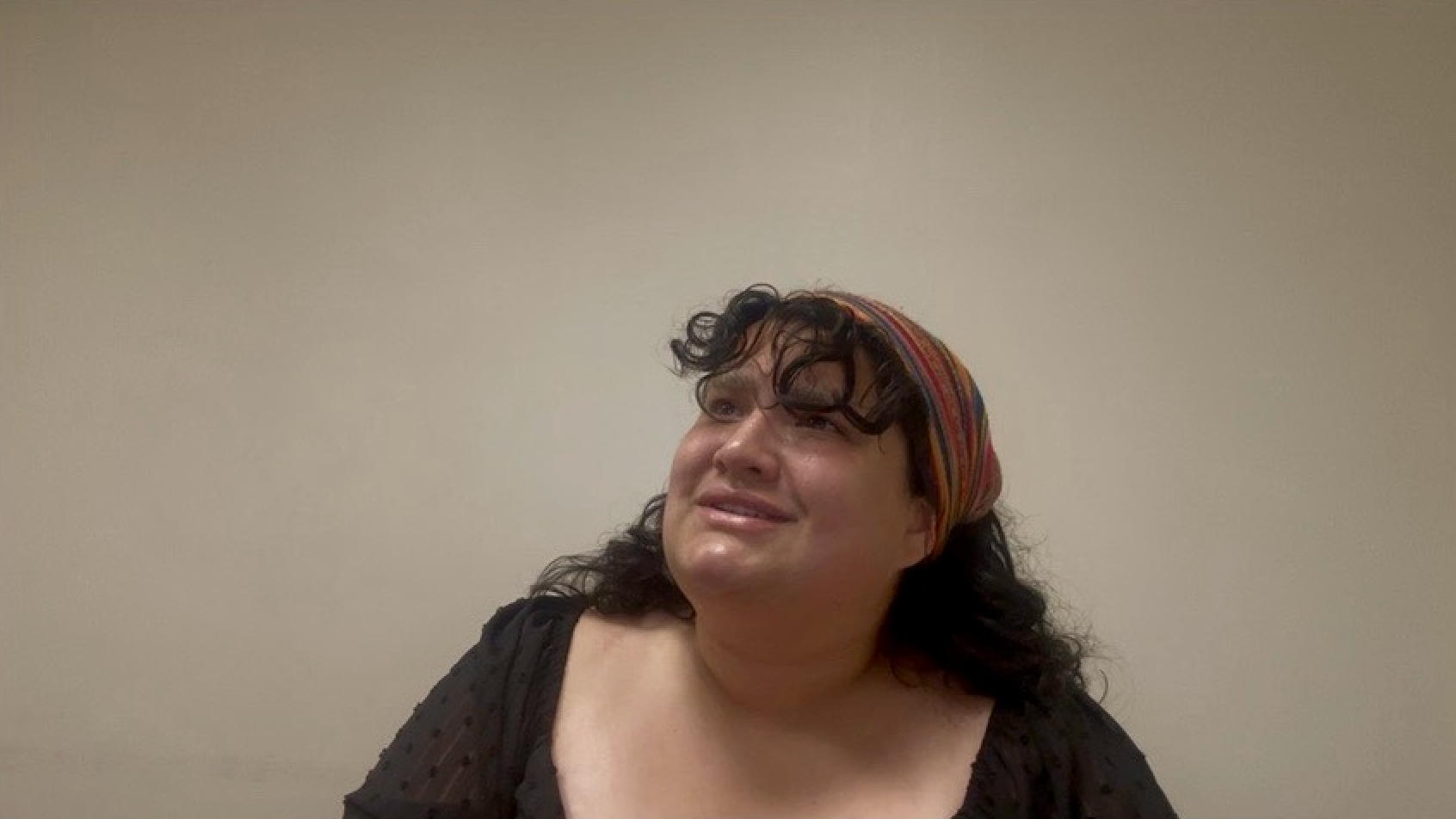
Note from the editors: Mundane Absurdities is a performance comprised of two monologues, Flowers and The Deli, which are conveyed through two separate video recordings. The two videos are available below the artist’s statement. As the videos are the primary form of the monologues, we invite readers to prioritize the videos, though transcripts of each have also been provided.
Artist Statement
This work examines the violence of deeply bureaucratic systems, emerging from countless ethnographic observations across various immigration court settings. As part of the project, I focused not only on the legal proceedings themselves but the broader environments that surrounded them: waiting rooms, hallways, security checkpoints, clerk’s windows, elevator rides, conversations before hearings, moments of confusion, moments of kindness, and the plethora of other interactions that collectively shape how this institution is experienced. Many of the feelings that remained with me after leaving court each day were not tied to any single case or event. Alternatively, they emerged from prolonged exposure to systems of waiting, procedural uncertainty, social observation, and the small negotiations required to move through unfamiliar bureaucratic spaces. From that came a series of eight monologues. For the purposes of this submission, I extracted and shortened two monologues—Flowers and The Deli—from the collection. The piece is abstract, oscillating between realism and absurdity. It is also important to note that this is not intended to “simulate” or flatten experiences into metaphor; rather, it uses embodiment to shed light on the invisible.
The Deli is perhaps the more direct of the two. While observing court, I was repeatedly struck by how much energy is devoted to learning and performing rules that are rarely stated explicitly. The numbered ticket system of a deli became a useful way of isolating and examining this experience. What appears absurd in the monologue is drawn from dynamics that felt deeply familiar. The piece explores how procedural systems create social worlds structured around waiting.
Flowers emerged from a separate set of observations. Throughout my time in court, I found myself increasingly attentive to moments of recognition. I saw smiles exchanged between strangers, a patient explanation from a clerk, brief moments of levity, and simple gestures from certain judges that seemed to acknowledge another person’s humanity within an environment largely organized around administrative necessity. These interactions were often small and easily missed but still seemed to carry disproportionate emotional weight. The monologue began as an attempt to think through why.
The flowers themselves become a way of exploring the significance that simple acts of kindness can take on in spaces marked by institutional distance. The line, “I almost started crying harder because I realized I had somehow convinced myself softness needed a witness. Or permission,” is about unexpected but appreciated care and small recognitions. Additionally, the speaker’s hesitation to buy herself flowers is not simply about loneliness; it is also about a learned uncertainty regarding what one is entitled to claim for oneself, emotionally and otherwise. In this sense, Flowers operates as a kind of double metaphor. The setting is intentionally mundane. It reflects on the emotional significance of small moments of care as well as the quieter ways these bureaucratic systems influence how people understand permission.
Taken together, these monologues employ theatrical abstraction to investigate the affective conditions that emerged through sustained observation of bureaucratic life—conditions that often translate better not when described, but when felt and embodied. By displacing those conditions into ordinary settings, the monologues create space to examine how systems are experienced not only through formal procedures, but through the habits and atmospheres they leave behind.
Flowers
I was just walking through the farmers market and then there they were just—
there.
In those stupid metal buckets, all lined up like they had somewhere to be.
And I picked one up and immediately put it back because you can’t buy yourself flowers in public.
It’s like they always have to mean something. An apology or a graduation or a death or LOVE or… someone remembering you.
And if I were to buy one for myself then there’s this horrible little moment where you realize no one else was going to.
I just didn’t expect it to feel so–
And then the lady smiled at me, a normal smile. Like this was ordinary, and I almost started crying harder because I realized I had somehow convinced myself softness needed a witness.
Or permission or–
I just couldn’t stand the idea of carrying them around.
So I left with nothing.
Which felt worse.
And somehow, more familiar.
The Deli
I love places like these with number systems, I mean, they’re kind of beautiful.
Everyone’s walking around all “normal” and “better than thou” and suddenly you’re spiritually connected to this small piece of paper so that someone can slice ham for you.
I mean, look at that guy, over there. His eyes haven’t left the board once; it’s like a whole military operation thing going on.
And then this woman keeps pretending to check her phone but she is CLEARLY not really checking her phone because every time the guy says a new number she pulls out her phone and looks at her locked screen, I mean–
It’s crazy.
And I just, want to be like, hey lady, it’s ok! We’re all waiting, here.
And then there’s all these unspoken rules, like…
There’s no line, but nobody’s telling you where to stand, or how often you can look at the board, or whether you are getting too close to the case if your number isn’t really soon and–
I made that mistake once.
Never again.
And of course there’s always one person who manages to miss their number because they wandered off somewhere there… or here… and it’s quite charming actually because suddenly everybody in the whole frickin’ building just becomes united in judgement. Like. You had ONE responsibility.
Which feels quite unfair honestly, because waiting is exhausting.
About the issue
This article is part of On Ethnographic Witnessing: Student Encounters with Immigration Court, a special issue of Semi-Structured. This collection features the work of 22 student ethnographers, who offer insights, analysis, and experiences based on hundreds of hours in immigration courtrooms across the country over the last few years. Through their work in observation projects under the direction of scholar-activists Lauren Heidbrink, Amelia Frank-Vitale, and Rebecca Galemba, students gained critical training in ethnographic practice and a crash course in immigration law, especially in the disjunctures between law on the books and law in practice. Understanding that wider audiences would benefit from hearing and learning directly from their students, Heidbrink, Frank-Vitale, and Galemba approached Semi-Structured to steward this thoughtful, ambitious collection. We are honored to run this issue and invite readers to consider what student observers witnessed, felt, and learned in court and why ethnographic observations are important to broader publics.
Semi-Structured is the open-access journal from the Public Ethnography Lab. The journal is dedicated to showcasing ethnography as it unfolds in the world. This journal exists because we believe ethnographic work matters beyond the academy—that the insights generated through sustained engagement with communities, organizations, and institutions can and should inform decisions, shape practices, and drive meaningful change.