

Making, Narrating, Knowing: Practicing Pottery as Public and Political Knowledge
Dr. Sangeeta Jawla is a potter, researcher, and performer from a traditional pottery family in northern India. Her work grows from lived experience with clay and long-term engagement with potter communities across India. Through her PhD research, she documented the stories, songs, and everyday practices of potters that focus on voices and knowledge often left out of formal records. She extends this research through performance and storytelling that create spaces where these narratives can be seen, heard, and felt beyond academic contexts. Her practice brings together making, research, and performance to position craft as a form of knowledge and lived expression.
Contact the author:drsangeetajawla@gmail.com
Affiliation
Independent Scholar, Educator, Potter, and Storyteller
Keywords
Material practice; gender and labour, practice-led research; public ethnography; embodied knowledge; storytelling traditions
Methodological Takeaway
This article develops a practice-led, community-based approach to research where knowledge emerges through making, storytelling, and embodied engagement rather than writing alone and evidences how pottery is a space where making, storytelling, and understanding come together.
“There was a potter who asked a god for a helping hand without explaining his needs. He was first given an elephant, but it was too large and expensive to keep in his small household. When he asked again, he received a camel, yet it could not carry clay without spilling it, and it was again a big animal that required a lot of maintenance. Finally, the potter asked more carefully by mentioning that he requires an animal that is smaller in size and feeds itself outside. This way he finally received an animal—a donkey that suited his work and life.”
In my pottery household, where each family member gathers for the pottery making process, where the wheel, the pottery tools, and the hands are smeared with clay, my grandfather would offer these tales that had circulated in pottery households for generations. As he worked, his hands and his voice were equally engaged in the process of making. Growing up in a family of potters in Haryana, I inherited a storytelling tradition where histories, ethical lessons, and community knowledge were part of everyday labour. In my grandfather’s workshop, I watched the turning of the wheel and listened to his stories that unfolded alongside the shaping of clay.
As I grew older, I kept my artistic heritage alive. Although I went on to study literature, folklore, and earned different certifications, one aspect of childhood stayed with me- the touch of clay and its stories. When I further entered the world of professional art, I felt a tension with what kind of knowledge was seen as legitimate. These academic spaces insinuated – or claimed directly – that knowledge is valued when it is written, structured, and formally taught.
Yet my own experiences challenged this monopoly on knowledge. My first analysis of pottery did not come from books or formal instruction, but from within my own family—through the rhythm of the wheel, the shaping of clay, and the quiet conversations that unfolded alongside making. These experiences suggested that craft traditions offer another way of knowing—one that comes through doing, through the body, and through sensory experience. My dual inheritance—of making and narrating— shaped my understanding of knowledge as inseparable from labour, practice, and social life. In pottery households, stories circulate as clay is kneaded, wheels turn, and vessels dry in the sun. Knowledge moves through gestures, memory, and rhythm, often carried in fragments—jokes, songs, and anecdotes—spoken in dialects and languages that rarely appear in formal archives.
When I decided to pursue my PhD eight years ago, I saw an opportunity to more diligently explore the meaning, significance, and lessons imparted by my family around the wheel, the clay, and the tools. I began collecting stories from my grandfather. Among them were stories like the potter’s donkey—humorous yet layered narratives that reflect the everyday thinking of artisanal life. These stories fascinated me because they are rarely written down, yet they hold insights about labour, need, and balance in a potter’s life. Over time, the project expanded into working with pottery communities across regions (from north to south India), and documenting their stories, techniques, and everyday pottery practices.
During this fieldwork, I confirmed that pottery is not just about making an object—it is a process shaped by history, labour, and shared knowledge. When a potter works, it is not only that the hands are involved in making. The clay has its own behaviour—sometimes soft, sometimes resistant. The wheel moves at its own pace. The pot emerges through constant adjustment between the body, the material, and motion. Writer and musician Sumana Chandrashekar describes this as a meeting of “bodies”—the earth, the maker, and the user—each shaping the other (2025, xix). In simple terms, a pot is never made alone. Hence, the pot has characteristics that are adapted in its making where human touch is involved.
This act of sharing and carrying forward stories from home is closely tied to memory. What is shaped in clay is also held in stories—stories that move across generations not as fixed narratives but as fragments, gestures, and conversations. Chandrashekar calls this a “struggle of memory against forgetting,” where past and present overlap (Chandrashekar 2025, xv). Pottery traditions work in similar ways. The stories of the pot emerge in pieces—through jokes, songs, and everyday making—and they are rarely written down. My research grew from gathering these fragments through listening, observing, and participating. While writing was my initial focus, it gradually shifted into shared spaces of orality, touch, and working with clay first-hand.
The time I spent in pottery households involved not only documenting processes but also understanding how labour is shared. In this sharing, the preparation of clay, the shaping of forms, and the connection between orality and material practice, I began to transform as an observer. Witnessing these everyday performances through gestures, tools, and clay, I gradually transitioned into a performer myself. What began as listening and observing slowly became embodied, where different senses allowed me to carry this knowledge forward.
As my research developed, I didn’t want to replicate the same norms I was researching against and wanted to impart these lessons in embodied, interactive, and multi-model formats- what I called democratisation. One of the earliest insights from the field was that potters rarely consider themselves storytellers in a formal sense. Unlike traditions such as Haryanvi Rāganī singing or folk theatre (my MA dissertation area), pottery communities do not have dedicated performance spaces for storytelling. Their stories emerge through everyday conversation while making pots. The act of crafting itself becomes a form of narration and performance. I conceptualized settings where participants engage with clay while listening to narratives collected during fieldwork, mirroring the layered experiences I felt as a child and in the field. I developed an approach that brought together fieldwork, personal reflection, and performance, which coalesce around four main offerings: {pottery sessions (Image 1), storytelling workshops (Image 2), performances (Image 3, 4, and 5), and exhibitions (Image 6 and 7).}. My colleague, Ashish K. Sharma, guided me in conceptualizing the performances. While these gatherings may sometimes focus on a particular offering, they often blend together as a way of listening to, learning from, and extending community knowledge as a shared and evolving practice rather than a fixed outcome.
Essay continues after images

Image 1: Pottery sessions with kids, National Museum 2025

Image 2: Storytelling sessions with kids, National Museum 2025

Image 3 and 4: Storytelling performance in Himachal 2024

Image 5: Storytelling Performance in Delhi, 2025

Image 6: Exhibition of Engraved clay pots, 2025
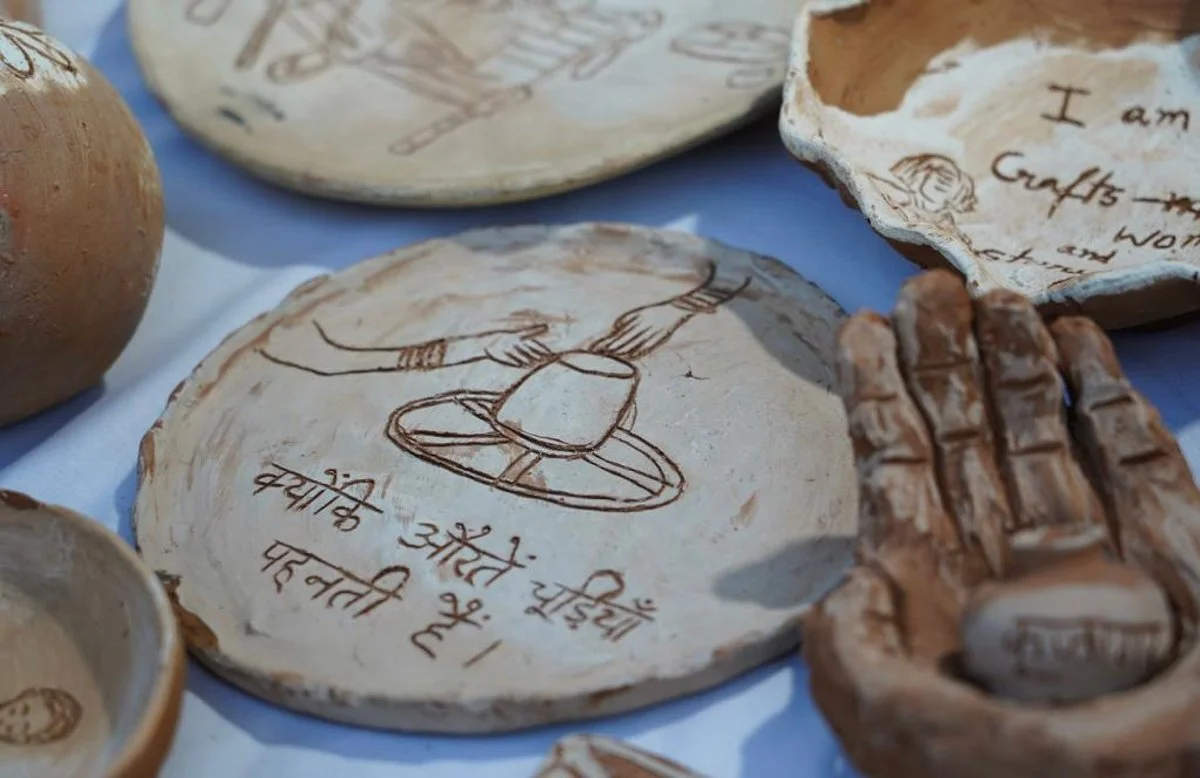
Image 7: Exhibition of Engraved clay pots, 2025
My pottery workshops, for instance, are always also storytelling performances. In these workshops, each participant receives a cue card with a fragment—a line, a memory, a story collected from my field trips (Image 8 and 9). This cue helps them connect to the narratives, the sensations, and the ways rural potters relate to clay. The warmth of the stories and the coolness of the clay begin to merge, drawing participants into a shared space of material and memory—one they may not have experienced first-hand. This is where the role of the storyteller, as a traveller between worlds, begins to connect them.
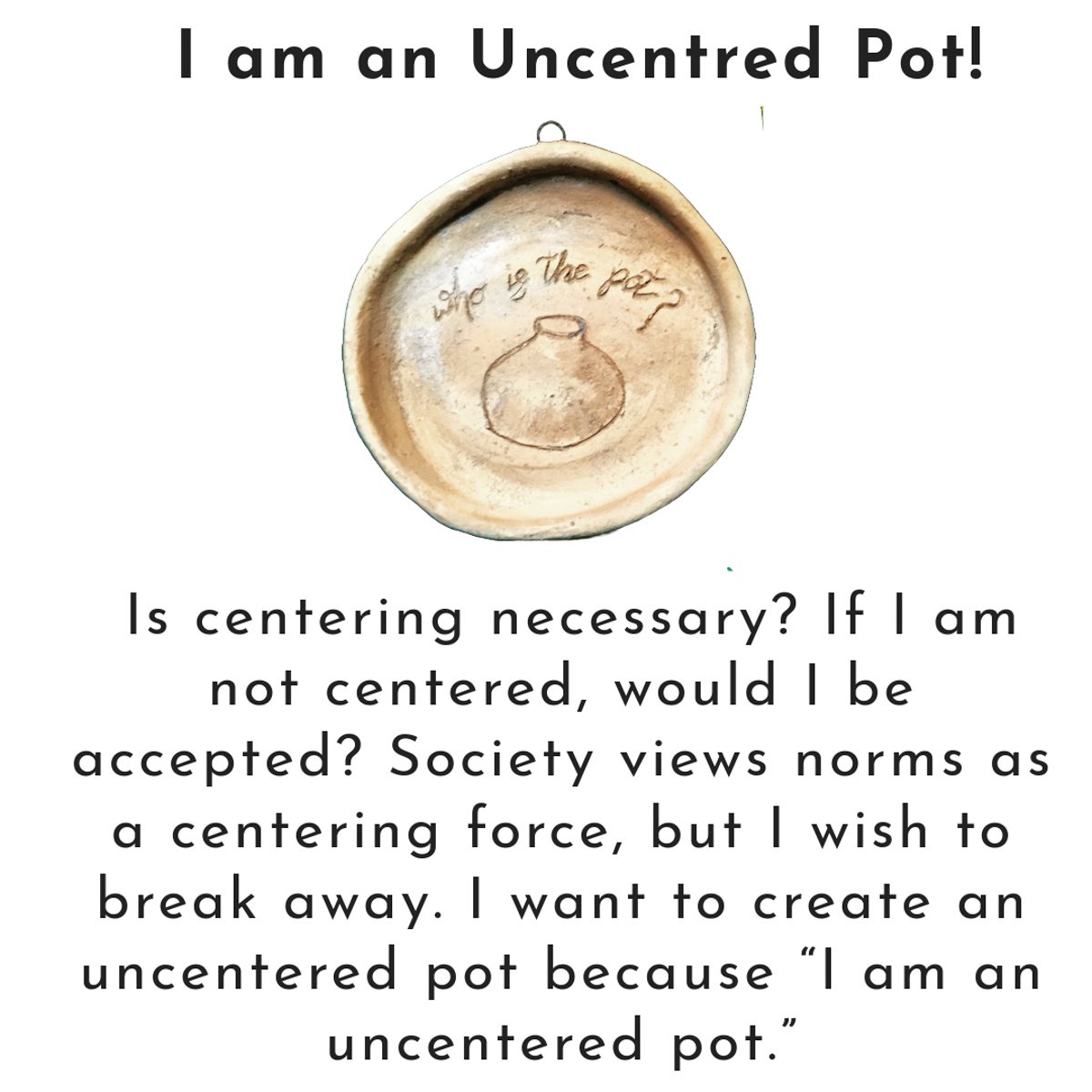
Image 8 and 9: Cue card used in Pottery making sessions

These sessions of sharing stories and making pots are filled with “sensational knowledge,” a concept Tomie Hahn develops. The connection between clay and hand touch is interwoven with the movement of the wheel. The softness of clay and the movement of the hands connect with the fast pace of the wheel. There is satisfaction, but also unpredictability—clay can collapse or resist. These experiences carry emotion: patience, frustration, joy, memory. Understanding emerges through touch and movement. As a performer, I move within this space and carry these narratives forward. What emerges is not just knowledge, but a felt experience.
In these performances and pottery sessions, the central idea explored is the politics of craft. In a performance called Who is the Pot?, the narrator asks how can one write about material without experiencing it? The performance, unlike academic writing, deepens the understanding of making through sensorial experience. It begins with a song and introduces the researcher as both storyteller and potter. Who is the Pot?, an idea drawn from my engagement with literary texts—particularly the use of personification as a strong literary device— draws on the story of Chameli, a woman I met in Rajasthan in 2017:
“Chameli kumhar ke paas kyun gayi? Kyunki ko ek handiya ki darkaar thi, jo vo khud bhi bana sakti thi, par kyuki vo ek aurat this to chaak nahi choo sakti thi.”
(Why did Chameli go to the potter? She needed a pot. She could make it herself, but she was not allowed to touch the wheel) (Image 10)

Image 10: Introduction of the performance with Chameli’s narrative
The performance demonstrates that pottery resists the separation of craft and knowledge. Potters transmit knowledge across generations, mentor apprentices, and negotiate complex material processes. Their work involves reflection, experimentation, and teaching—activities that parallel academic intellectual labour. This perspective also resonates with South Asian knowledge traditions such as the guru–shishya (teacher- disciple) lineage, where learning occurs through observation, shared labour, and relational ethics rather than through textual instruction alone. Craft guilds historically functioned as educational spaces where knowledge was transmitted through apprenticeship and collective practice. Such traditions highlight alternative pedagogies that integrate making, storytelling, and ethical relations between teacher and student.
The performance reinforces the notion that art cannot exist outside of social realities. A clay pot is simultaneously a utilitarian object, an aesthetic form, a marker of caste-based labour histories and evidence of gendered restriction: women contribute labour but are kept away from the wheel. In many pottery households, men are seen as artisans because they use the wheel, while women knead clay, carry water, and decorate pots. This imbalance becomes clear in Chameli’s story. The wheel is not just a tool—it is a boundary. When I began performing Chameli, I chose to stay with this moment rather than move past it. Standing with clay in my hands, I speak her lines slowly—sometimes in Hindi, sometimes in English—allowing the audience time to sit with what is being said. There is often a noticeable shift in the room: it begins with a sense of familiarity, sometimes even humour, and then gradually settles into a pause as the meaning takes hold. That pause becomes important. Some audiences respond with silence, while others respond with recognition—particularly women who connect with the experience of being close to a practice, of knowing it intimately, yet being kept at its edges.
For me, embodying Chameli is not about representing someone else, but about stepping into a shared condition. As I shape clay during the performance—sometimes working on the wheel, sometimes deliberately away from it—I become aware of the tension between access and restriction, between knowing how to do something and not being allowed to do it. The performance stays within this tension rather than resolving it. In doing so, the absence of women at the wheel becomes as visible as their constant presence around it. The story unfolds not only as something spoken, but as something felt in the body—lingering as a lived condition rather than a distant narrative.
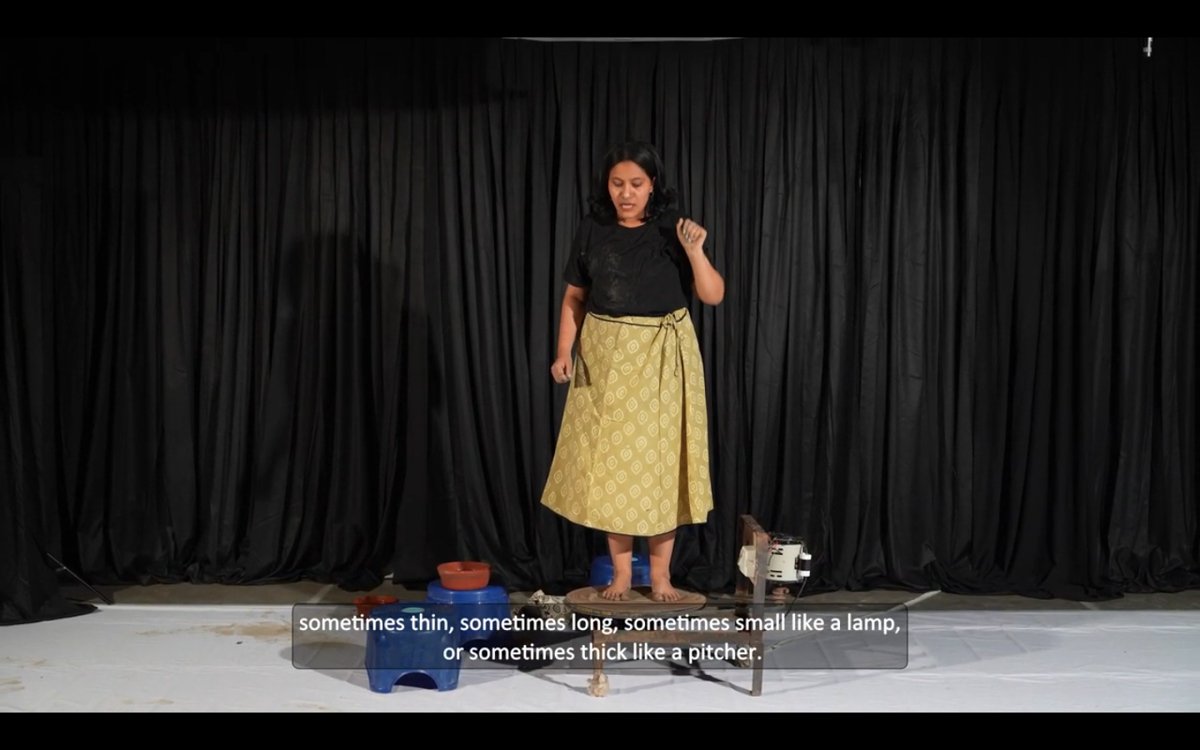
The lessons from this performance prompted another piece—When Woman Becomes the Wheel Herself, where Chameli is not just speaking about the taboo of touching the wheel, but also bringing the stories of many women onto the stage. Each woman comes from a different household, from different parts of India, yet they gather around a shared question and a shared material: Is clay masculine or feminine? (Image 11) The performance invites the audience to reflect on the movement of the wheel and the movement of a woman’s body shaping clay in its absence. It also explores a woman’s desire to become clay herself, as she says:
“Agar mujhe bhi mitti ki tarah chaak par rakha jaaye to. To main bhi kabhi patli to kabhi lambi, kabhi diye jaisi choti to kabhi matke jaisi moti.”(If I, too, were placed on the wheel like clay, I could be shaped into many forms—sometimes thin, sometimes tall, sometimes as small as a lamp, sometimes as full as a pot.) (Image 12)
This moment—of imagining the body as clay and clay as something beyond gender—opens the work outward. It shifts the focus from restriction to possibility, from what is denied to what can still be imagined and felt. The performance lingers here, where material, memory, and desire begin to overlap, asking us to see making not just as labour, but as a way of thinking and becoming.

Image 11 and 12: The narration of women in connection to clay and the wheel, When Woman Becomes Wheel Herself, Museo Camera, 2024
In the end, the work returns to the quiet, familiar act of shaping clay and sharing stories. A pot carries more than form—it holds touch, rhythm, and the lived experiences of those who make it. When we begin to notice this, we realise that knowledge is not limited to written words. It exists in the body, in gestures, in repetition, and in everyday practices that often go unnoticed.
In each of these gatherings, binaries are fundamentally challenged. Through these modes of sharing—the artist and the audience come close, the boundaries of rural and urban are blurred, the knowledge of academia and public merge.
This is true for my own role in the work, as an insider and a researcher. My familiarity gives me access to intimate spaces of making and narration, but it also requires distance—an awareness of what feels natural and may go unquestioned. I am shaped by the same caste-based labour structures and gendered divisions that organise this practice. While I inherit these traditions, I remain attentive to how women’s work is often overlooked, and how my position allows some forms of access while limiting others.
In my work, the research moves through listening, participating in everyday labour, and gathering fragments of stories that circulate through practice. These fragments—spoken, enacted, and remembered—are central to understanding how knowledge is formed and shared. The pottery-making sessions, storytelling workshops, and performances extend this process by creating shared spaces where participants learn through touch, movement, and sensory experiences.
Here, clay is not only a material but a way of thinking, where understanding develops through doing. Learning and knowledge unfold collectively and are further shaped by interactions rather than instructions. In this approach, research is built in relation with communities rather than just extracted from them. The narrative, the gestures, and the material practices act as methods of inquiry, while performance carries these experiences into new contexts. This challenges the hierarchy that privileges written knowledge by recognising embodied skill and practice as intellectual labour. At the same time, the methodology remains attentive to caste, gender, and access, asking whether institutions can sustain and value knowledge beyond text.
Through pottery, storytelling, and performance, my work is an invitation to slow down and engage differently—to listen, to touch, and to recognise what is often left unsaid. It asks us to rethink whose knowledge matters and how it is shared. For a wider audience, this becomes an invitation to participate: to work with clay, to sit with stories, and to experience how understanding can emerge through doing. In that shared space, making, narrating, and knowing come together—reminding us that knowledge is something we live, feel, and create together.
References
Chandrashekar, Sumana. Song of the Clay Pot: My Journey with the Ghatam. New Delhi: Speaking Tiger Books, 2025.
Hahn, Tomie. Sensational Knowledge: Embodying Culture through Japanese Dance. Wesleyan University Press, 2007.