

What gets remembered? An Ethnographic Exploration of Gentrification and Lead Poisoning in New York City
Dr. Paul Odér is an assistant professor of criminology at Eastern Illinois University. His research centers on lead poisoning, gentrification, and carceral politics, and his public scholarship and advocacy work focuses on housing/tenant rights and public health in New York City.
Contact the author:
Email: poder@eiu.edu
Website: https://pauloder.framer.website/
Keywords
Walking ethnography; lead poisoning; gentrification; archival document analysis; public health; walking interview; industrial churning
Methodological Takeaway
The walking ethnography is a tool for embodied learning – a process in which the researcher decenters themselves, and instead lets movements, sights, sounds, and hearing lead the way. Through this emplacement, the walking ethnography took me away from the top-down analysis of my initial research and embedded me within the fabric of a neighborhood facing multiple forms of gentrification, environmental fallout, and public health issues. Triangulated with other qualitative methodologies, the walking ethnography can be a vehicle for connecting the past to the present, and for interrogating the multiple visions, framings, and understandings of complex social processes in the world around us.
AI Statement:
No artificial intelligence (AI) services were used to create this manuscript nor to conduct the research described within.
Introduction
What gets remembered? Walking through Greenpoint in the cold early days of 2025, I kept returning to this question. A sign marking Hurricane Sandy’s waterline. A map of “places of interest” that turned out to be a map of buried industrial sites. A high-end restaurant in a former glass factory, its toxic past absorbed into the neighborhood’s new aesthetic.
I had come to Greenpoint to unravel something that my statistical research hadn’t been able to explain. Analyzing gentrification’s impact on lead poisoning across New York City from 2010 to 2020, I found a positive association between the two — a finding that cut directly against the claims of municipal policymakers and public health practitioners who had long proposed gentrification as a solution to inadequate housing and entrenched legacies of lead poisoning. If that argument held anywhere, it should hold in Greenpoint: one of Brooklyn's most intensely gentrified neighborhoods, and the site of New York City’s highest rates of childhood lead poisoning.
Personally, I had rarely visited the neighborhood, spending most of my time in East Harlem, a place that reminded me of my East African upbringing. What I knew of Greenpoint came from friends and colleagues — many of them new arrivals like me, unaware of the histories buried beneath the gentrification that we and our universities contribute to across the five boroughs. My own field of criminology engages with lead poisoning insofar as it correlates with street crime, an oversight that leaves lead’s structural and slow violence [1] unquestioned. I had learned to distrust this predominant framing, but I knew that critically engaging with lead poisoning would require interdisciplinary theoretical and methodological innovations.
My answer was a walking ethnography — four walks through Greenpoint's streets, beginning at the northernmost edge along the Newtown Creek and moving progressively south toward Williamsburg, attending to construction, demolition, renovation, and the quiet rebranding of industrial sites into boutiques, restaurants, and luxury apartments. Triangulated with a walking interview with Cole, a fourth-generation Greenpoint resident and environmental justice organizer in the neighborhood, and an archival analysis of newspaper articles and mayoral memos, the walks became a relational mirror — a way of connecting what I could see to what others remembered and what the documents revealed.
What I found was this: gentrification does not reduce or eliminate lead poisoning in Greenpoint. It obscures it.
Walking Ethnography
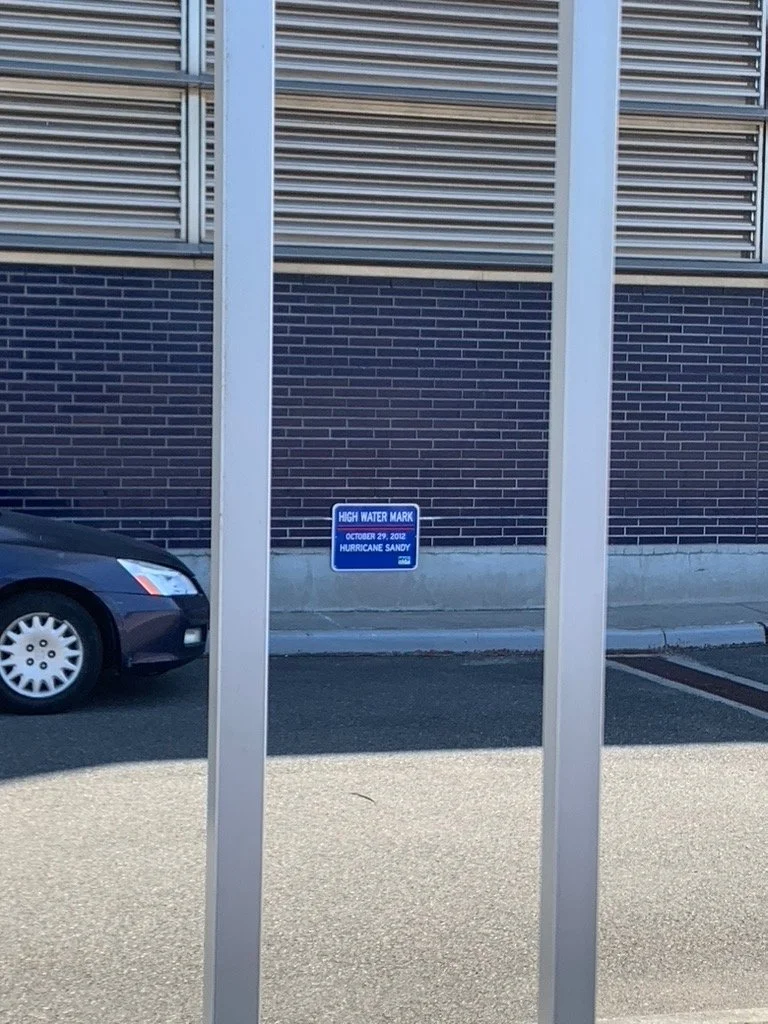
Figure 1 – A sign in Northern Greenpoint that shows the water mark reached by Hurricane Sandy (photo by author)
My first walk began on January 3, 2025. Starting at the corner of Greenpoint Avenue and Manhattan Avenue, I walked east and saw boutiques and bodegas give way to fenced-off lots, industrial depots, and eventually Kingsland Wildflowers, a public garden and environmental education hub. At every point of this walk, Greenpoint’s industrial past and environmental issues were apparent – from the Newtown Creek Wastewater Treatment Plant and signage warning residents to avoid eating fish from the creek, to a sign commemorating Hurricane Sandy (see Figure 1). Nevertheless, I found no clear, visual connection to Greenpoint’s once prominent industrial production of lead products in this initial walk.
Still, this first walk was fruitful. Seeing the Hurricane Sandy commemoration sign led me to ruminate over Maura Finkelstein’s The Archive of Loss – an ethnography focused on the industrial livelihoods of mill workers within post-industrial Mumbai. I thought about a quote from her work that “once spaces and communities are erased from our social vision, we must relearn how to see what exists but has been rendered invisible” (Finkelstein 2019, p. 15). Reflecting on this sign, I wondered – what gets remembered? Which events are transformed into a crisis? And which events become nothing, banished to a status of non-memory? These questions would guide me as I continued my walks.
Starting at India St and Manhattan Avenue, I looped northward, retracing the end of my first walk along Manhattan Avenue before turning eastward to end at Manhattan and Clay St. This route took me along the waterfront. As I walked, I came across Manhattan Avenue Park, and a map located at the park’s entrance (see Figure 2). Depicting Greenpoint’s “places of interest”– many of which were notable industrial sites, both for industrial production and environmental devastation – the map led me to expect their older form would match their modern appearance. Instead, what I discovered in later walks was a process of active disremembrance, as gentrification facilitated the remediation of toxic brownfields into commercial and residential spaces.
An example of this active disremembrance is an active construction site for a new, mixed-use building near the Newtown Creek waterfront (seeFigure 3). A seemingly active site yet devoid of activity when I observed it, the new construction lay just a street away from the Newtown Creek high-rise luxury apartments, a prominent symbol of Greenpoint’s gentrification and the lasting impact of Mayor Bloomberg’s rezoning agenda. I initially saw this site as an example of residential gentrification alone, heralded without critique by Yes in My Back Yard (YIMBY) [2] online publications for its allotment of “affordable” apartments. Later, however, my archival analysis unearthed the site’s recently toxic past. This now complete mixed-use building sits atop the NuHart Plasticizer Plume, an active Superfund site.
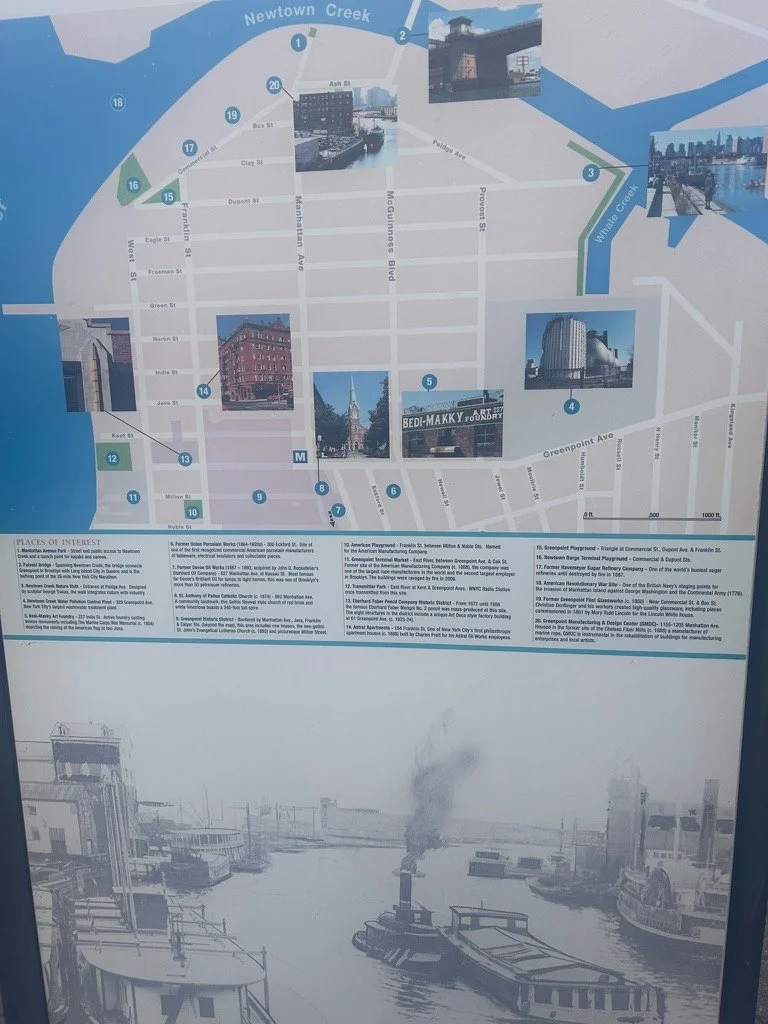
Figure 2 – A map within Manhattan Avenue Park showing Greenpoint’s places of interest (photo by author)
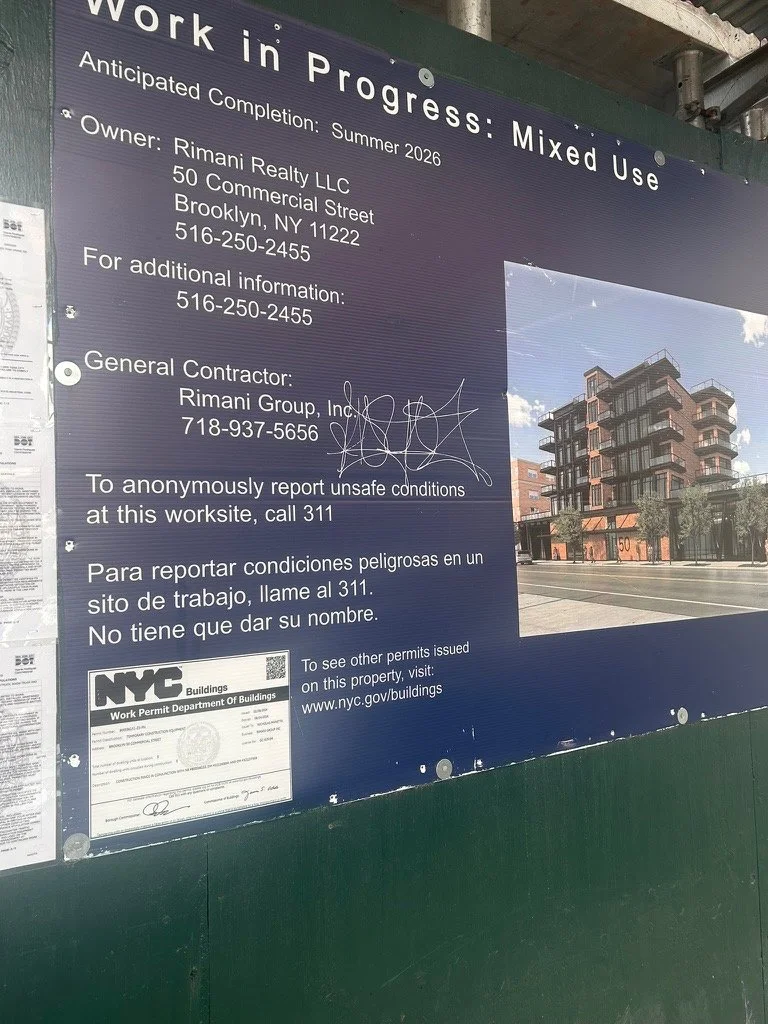
Figure 3 – Construction site for a new, mixed-use building near the Newtown Creek waterfront (photo by author). This site stands atop the NuHart Plasticizer Plume.
On my third walk, I started at the corner of Calyer & Jewel Street, branching west towards Eckford St, and ended my walk at Manhattan and Nassau Avenue. While some sites bore descriptions or signage related to their former use, others were rebranded, their names absorbed into the fabric of modern-day Greenpoint. While some rebrands were obvious – a pencil carving left in place at the now repurposed Eberhardt Pencil Factory, or a dive bar named after the same site – others escaped me. These innocuous rebrands included art galleries, shared workspaces, or Glasserie – a high-end restaurant that I would later learn was the former site of the Greenpoint Glass Works, a factory in operation during the 19th and 20th centuries. For each of these sites, no particular signage indicated its significance to Greenpoint’s industrial past; instead, they were woven into the everyday activities within the neighborhood. Even the Eberhardt Pencil Factory, now converted into workspace condos, appeared detached from its former industrial use. It would be Cole – my walking interviewee and a fourth-generation Greenpoint resident – who later showed me a pencil carving high up on the building’s southern face, and the sole remnant of the site’s formerly industrial use.
On my fourth walk, I started at the corner of Norman Avenue and Leonard St, an intersection reflective of Greenpoint’s commercial gentrification as long-term Polish shops and newly arrived boutiques sat side-by-side (Trinch and Snajdr 2020). From here, I branched southeast until I arrived at McCarren Park. Piqued by its desert-like appearance in the dead of winter, I would later learn that this park contained EPA actionable levels of lead in its soil. These toxic lead levels, discovered by a local community group, were compounded by city hall’s declaration that only the potential construction of a government-owned building would see the toxic soil removed. In a sense, this naked admission of limited governance mirrored the benign neglect and planned shrinkage that had plagued Black and Brown communities across New York City throughout the 1970s and 1980s. [3]
Walking Interview and Archival Research
My walk with Cole provided a chance to revisit the sites from my walking ethnography while also seeing sites and stories I had overlooked. As a local expert, Cole’s familiarity filled in my tentative ethnographic findings with his experiential expertise and enabled me to actively imagine Greenpoint as Cole lived and remembered it. As Cole conjured a past that no longer exists, sites once invisible were made readily visible, including a once six-lane expressway built atop his grandmother’s home, now narrowed to four lanes after a schoolteacher was hit and killed; or a six-story apartment built atop the empty lot where he once made igloos as a child. His insider knowledge showed me a Greenpoint that used to exist; his walking interview even showed the contending visions for the neighborhood, as a woman approached him during our walking interview to complain about his street safety advocacy. After an initial shock to us both, this moment allowed Cole to explain how long-term and newly arrived residents, whilst often frequenting the same places, could hold drastically different visions for how the neighborhood should be.
The corroboration and refining that I received from Cole was made complete through my document analysis. Searching newspaper articles and library collections, I found a process of environmental gentrification in Greenpoint (i.e., co-opting the goals of the environmental justice movement for high-end development profits), with one site in particular standing out. Located near the construction site depicted in Figure 3 and sitting atop the same NuHart Plasticizer Plume is a two-building complex dubbed “Greenpoint Central”. Glossy pictures and precise descriptions of tenant amenities can be found on Greenpoint Central’s website, along with a proud announcement that this site received the Public-Private Partnership of the Year from the Commercial Observer, a media company in service of “the global real estate landscape”. These sleek designs and a prestigious award distract from the dark history of this site. Irked by a lengthy remediation process, Madison Realty Capital – a private equity real estate firm that financed the site’s development – mixed concrete into the contaminated soil rather than removing it entirely. Claiming that the toxic soil had surpassed their initial predictions of its depth, Madison Realty Capital – with the blessing of the Department of Environmental Conservation – finished construction in 2024.
Findings
I took this site into account along with my ethnographic walks and Cole’s insights, all of which spoke to gentrification-induced changes near and along the same streets where Greenpoint Central stands. I theorize that this complex, along with the construction site depicted in Figure 3, reflects the neighborhood’s intense residential, commercial, and environmental gentrification.
In Sites Unseen (2018), Scott Frickel & James Elliott argue that local urban change is driven, in part, by industrial churning, which “changes urban environments as land redevelopment and reuse continually clear away visible signs of sites’ industrial pasts and...relic wastes” (p. 26). Through a churningprocess, lax if not nonexistent environmental procedures from responsible industries or governmental agencies facilitate a purposeful dissolution of industrial pollution from public memory (Frickel and Elliott 2018). This process, as well as residential and commercial gentrification, was visible throughout my walking ethnography. Gentrification, rather than reduce or eliminate lead poisoning, obscures it through developer-state relations that minimize lead toxins and other environmental harms within the neighborhood. Typecast as an ailment found in disadvantaged neighborhoods alone, lead poisoning is instead present within Greenpoint due to an unaddressed legacy of industrial pollution.
The aforementioned industrial churning also relates to Greenpoint’s relationship with street crime, as my walking interview and archival document analysis revealed that industrial churning occurred most intensely in the 1970s-1990s, a period where the neighborhood experienced deindustrialization and economic abandonment, which then saw increased youth violence and intense policing.
Methodological Value
The notion that gentrification could eliminate childhood lead poisoning fails to politicize gentrification as a process that preys upon the working class. Instead of providing new lead-free homes to the majority of working-class victims of lead poisoning, gentrification would sooner provide luxury apartments and housing to incoming gentrifiers while displacing long-term residents into older, toxic housing. Moreover, the process by which gentrification “addresses” sites of formerly industrial usage is meant to diminish any toxic remnants. Using the historical ignorance of incoming gentrifiers to their advantage, private equity and real estate developers cast a light of modernity upon Greenpoint and hurriedly detach the neighborhood from its less-than-neat ties to industrial pollution, disinvestment, and state-sanctioned environmental harms. Relying on the displacement of long-term residents like Cole, their increasingly uncontested vision for the present and future proclaims that “politics is done”; there is but one way to create housing, and it just happens to be theirs.
And yet the aforementioned processes of environmental gentrification and churning are absent within public health scholarship on gentrification, with public health scholarship frequently lacking “a specific theoretical or historical framing for why gentrification may affect health” (Schnake-Mahl et al. 2020). This gap may explain how gentrification could even be proposed as a solution to lead poisoning. This idea, posed by self-termed “pragmatic” public health scholars who saw diminished funding and a declining environmentalism movement as a permanent condition, is often partnered with secondary prevention measures aimed at managing but not preventing lead poisoning. This “enfeebled” stance (Needleman 2002) not only shirks public health responsibilities but reflects what Harvey (1974) terms the ethical neutrality assumption – a notion that science and politics must be conducted within separate arenas. Within lead poisoning research, this assumption is a stumbling block that produces pathological research divorced from the structural harm perpetuated by the industry and enabled by an insincere public health.
Instead, I argue here that public health, criminology, and academia must engage in a public scholarship that problematizes social harm beyond conventional or official definitions. And for the topic at hand – gentrification as a solution to lead poisoning and interpersonal violence – we must be unafraid to contest gentrification’s common framing as a value-neutral process, or the insincere solutions offered for the reduction and eradication of lead poisoning and interpersonal violence.
Reflections
The walking ethnography enabled me to conduct “a geography of rhythm” through which I was emplaced within Greenpoint (Springgay, 2011). Abandoning the academy’s common refrain for detached and apolitical research, the walking ethnography enabled me to observe the small details of everyday life “that may contain the potential to develop or question big theories” (Novoa, 2015). Through the walking ethnography, I produced work that sees lead poisoning as one of many environmental harms within gentrified Greenpoint.
As I conducted my case study, my walking ethnography provided a relational mirror upon which I could compare Cole’s experiences and knowledge and the results of my archival document analysis. This relational aspect proved critical, producing ethnographic insights that guided my subsequent interview and document analysis. Through triangulation, my walking interview and archival document analysis contextualized and corrected my walking ethnography through the histories of industrial pollution and social succession imparted by my interviewee and the archival data. Moreover, walking ethnography connected to Cole’s insights from our walking interview, as our shared walk operated as an active and open review of my ethnographic insights and theorization.
Innovative qualitative methods, triangulated as I’ve shown here, provide a pathway for pioneering, multidisciplinary work. In particular, the walking ethnography becomes a means of forsaking top-down analysis – one that begins not at the top, but from the street, sustained by the people who have lived what statistics can only approximate.
Endnotes
[1] Structural violence is any avoidable, societal limitations placed upon people that constrains them from meeting their basic needs, and achieving a quality of life that would otherwise be possible (Lee 2019) while slow violence is “a violence of delayed destruction that is dispersed across time and space, an attritional violence that is typically not viewed as violence at all” (Nixon, 2011, p. 2). Both structural and slow violence are seldom mentioned in the criminological literature, which instead focuses on street crime and interpersonal violence.
[2] In short, Yes in My Back Yard is a housing stance that sees all forms of housing development as beneficial. By critique, I refer to the misleading nature of the “affordable” designation, a metric created by the US Department of Housing and Urban Development that groups New York City’s boroughs with high-earning, upstate populations of Rockland, Westchester, and Putnam counties.
[3] Benign neglect and planned shrinkage policies involved the active withdrawal of state services and infrastructure from marginalized, non-white neighborhoods. In effect, these policies facilitated private companies to do the same (Aalbers 2014).
References
Aalbers, Manuel B. “Do maps make geography? Part 1: Redlining, planned shrinkage, and the places of decline.” ACME: An International Journal for Critical Geographies 13, no. 4 (2014): 525-556.
Cole, Helen VS. “A call to engage: Considering the role of gentrification in public health research.” Cities & Health 4, no. 3 (2020): 278-287.
Finkelstein, Maura. The archive of loss: Lively ruination in mill land Mumbai. Duke University Press, 2019.
Frickel, Scott, and Elliott, James R. Sites unseen: Uncovering hidden hazards in American cities. Russell Sage Foundation, 2018.
“Greenpoint Central.” Greenpoint Central. Accessed May 25, 2026. http://www.greenpointcentral.com
Harvey, David. “Population, resources, and the ideology of science.” Economic Geography 50, no. 3 (1974): 256-277.
Lee, Bandy X. Violence: An interdisciplinary approach to causes, consequences, and cures. John Wiley & Sons, 2019.
Needleman, Herbert L. “What is not found in the spreadsheets.” Neurotoxicology and Teratology 24, no. 4 (2002): 459-461.
Nixon, Rob. Slow violence and the environmentalism of the poor. Harvard University Press, 2011.
Novoa, Andre. “Mobile ethnography: emergence, techniques and its importance to geography.” Human Geographies: Journal of Studies & Research in Human Geography 9, no. 1 (2015).
Springgay, Stephanie. ““The Chinatown Foray” as sensational pedagogy.” Curriculum Inquiry 41, no. 5 (2011): 636-656.
Trinch, Shonna, and Snajdr, Edward. What the signs say: Language, gentrification, and place-making in Brooklyn. Vanderbilt University Press, 2020.