

The Hopeless Observer
About the Author: Stacey Montoya is an undergraduate student at California State University, Long Beach, majoring in Anthropology and Political Science. She participated in Justice In View observing in the North Los Angeles Immigration Court.
Abstract: Courtwatching can feel helpless, but documenting what happens turns observation into public witness and a call for change.
Keywords
Los Angeles, helplessness, witnessing, accountability
Citation
Montoya, Stacy. 2026. “The Hopeless Observer.” Semi-Structured (Washington, D.C.), On Ethnographic Witnessing: Student Encounters with Immigration Court, vol. 1 (3). https://doi.org/10.57912/34050540.
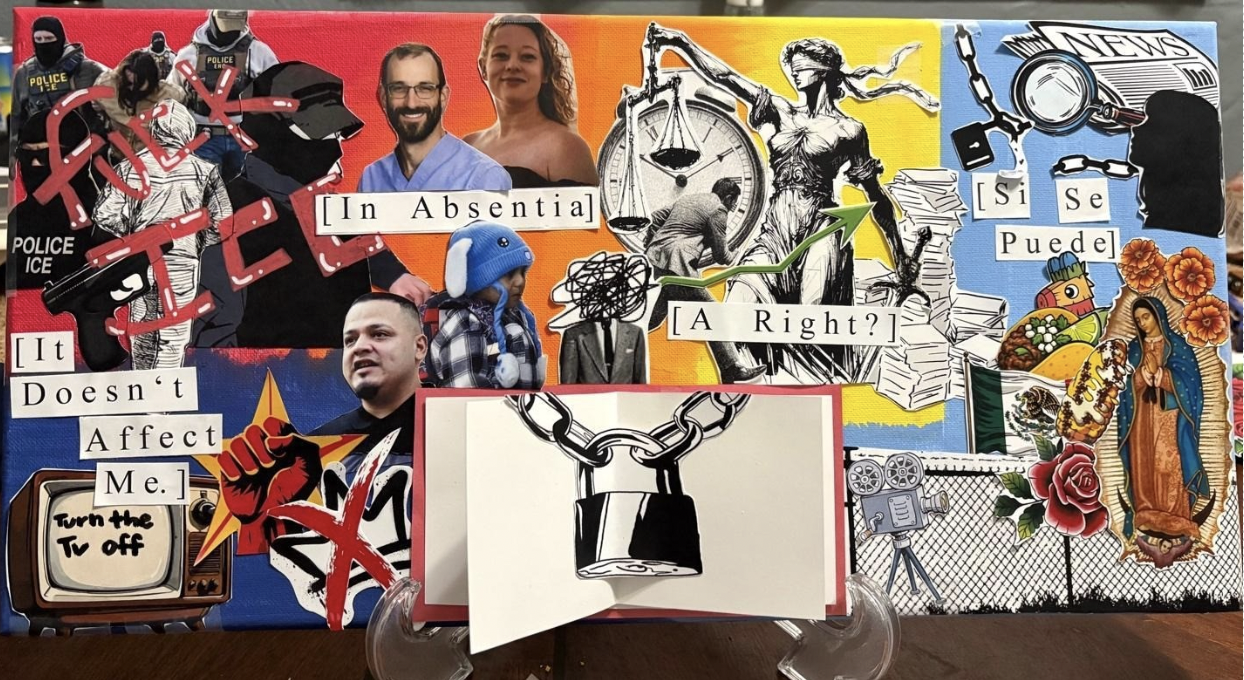
This piece is meant to encapsulate the emotions I felt throughout my time observing in North Los Angeles Immigration Court. The locked journal represents a feeling of helplessness as an overwhelming number of events occurred around me, events I was trained to just observe and document. The lock only breaks once my observations are shared with a wider public, as my work finds new meaning by holding these actions accountable. The phrases spread throughout this painting each represent persistent feelings I experienced while doing this work: frustration towards individuals refusing to get involved (“It Doesn’t Affect Me”), hopelessness as many are deported and some killed (“In Absentia”), and empowerment in knowing that I alongside many others can help initiate change (“Si Se Puede”).
About this issue
This article is part of On Ethnographic Witnessing: Student Encounters with Immigration Court, a special issue of Semi-Structured. This collection features the work of 22 student ethnographers, who offer insights, analysis, and experiences based on hundreds of hours in immigration courtrooms across the country over the last few years. Through their work in observation projects under the direction of scholar-activists Lauren Heidbrink, Amelia Frank-Vitale, and Rebecca Galemba, students gained critical training in ethnographic practice and a crash course in immigration law, especially in the disjunctures between law on the books and law in practice. Understanding that wider audiences would benefit from hearing and learning directly from their students, Heidbrink, Frank-Vitale, and Galemba approached Semi-Structured to steward this thoughtful, ambitious collection. We are honored to run this issue and invite readers to consider what student observers witnessed, felt, and learned in court and why ethnographic observations are important to broader publics.
Semi-Structured is the open-access journal from the Public Ethnography Lab. The journal is dedicated to showcasing ethnography as it unfolds in the world. This journal exists because we believe ethnographic work matters beyond the academy—that the insights generated through sustained engagement with communities, organizations, and institutions can and should inform decisions, shape practices, and drive meaningful change.