

Chains (Art Piece)
About the Author: Maryna Marzeena received her Bachelor of Arts in psychology from California State University, Long Beach in May 2026. She is pursuing a Doctor of Psychology (PsyD) in Clinical Psychology with an emphasis in Forensic Psychology at Azusa Pacific University starting August 2026. Her long-term goal is to become a licensed Forensic Psychologist and work with minority justice-involved individuals. She participated in Justice In View in the San Diego immigration court.
Abstract: The violence of power was clear even before I stepped into the courthouse.
Keywords: San Diego; enforcement; fear
Citation
Marzena, Maryna. 2026. “Chains.” Semi-Structured (Washington, D.C.), On Ethnographic Witnessing: Student Encounters with Immigration Court, vol. 1 (3). https://doi.org/10.57912/34113330
Chains
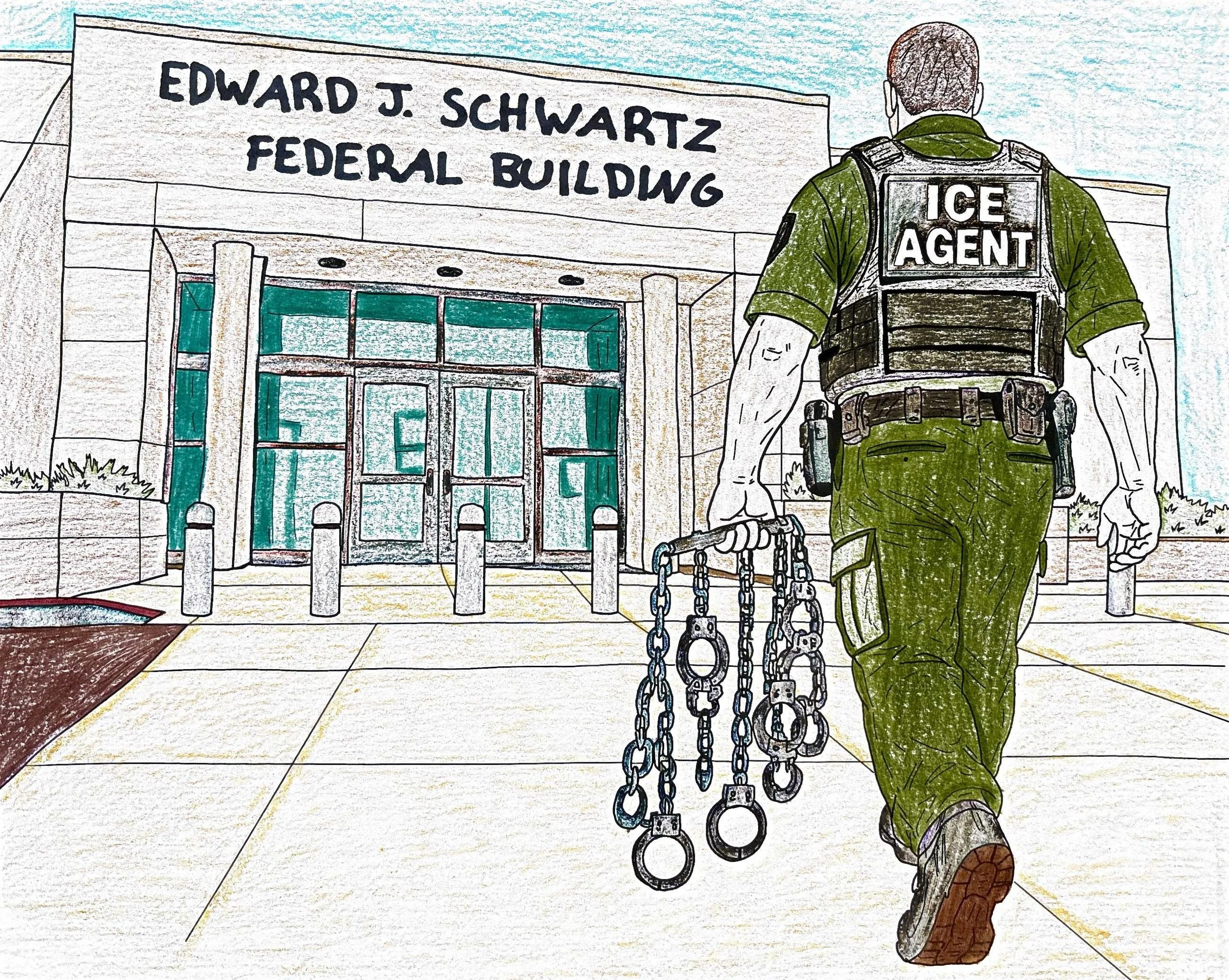
Artist Statement
My observations in immigration court had a powerful impact on me because they allowed me to see the legal system not as an abstract idea, but as something that directly shapes people’s lives, families, and futures. One moment that stood out to me happened before I even entered the courtroom. While waiting in the security line outside the courthouse, I heard the loud clanging of chains and turned to see an officer carrying multiple handcuffs and chains in a way that made their noise impossible to ignore. His imposing presence drew the attention of all those around him, who instinctively turned to look. His stoic expression and purposeful stride conveyed quiet determination as he approached the employee doors adjacent to the main entrance. In Chains I captured the moment in my drawing, trying to convey the intensity of the scene.
I felt genuinely scared and intimidated by this environment. That moment made me realize how power is not only exercised inside the courtroom, but also communicated through presence, sound, and atmosphere. Through observing inside and outside of court, I learned that I am more empathetic and observant than I realized, and that I am deeply affected by situations where people face fear, uncertainty, and unequal power. It also reinforced that behind every “case” is a real person with a story, not just a file or case number, and helped me better understand the importance of professionalism, fairness, and compassion in careers within law and public service.
In drawing Chains, I wanted to capture the moment that stayed with me the most. I chose to draw the detention officer carrying the chains because it was the first moment that made the reality and intensity of the immigration court tangible to me. Before stepping inside the courtroom, the sound of the chains and the officer’s presence created an atmosphere of fear and intimidation. I wanted the drawing to communicate that power is often felt before a single word is spoken, and that the emotional weight of the legal system extends beyond the courtroom itself.
As an immigrant myself, observing immigration court felt especially personal. Although my own journey is very different from those I observed, it reminded me that immigration is never just a legal process; it is deeply connected to people's identities, families, and futures.
About this issue
This article is part of On Ethnographic Witnessing: Student Encounters with Immigration Court, a special issue of Semi-Structured. This collection features the work of 22 student ethnographers, who offer insights, analysis, and experiences based on hundreds of hours in immigration courtrooms across the country over the last few years. Through their work in observation projects under the direction of scholar-activists Lauren Heidbrink, Amelia Frank-Vitale, and Rebecca Galemba, students gained critical training in ethnographic practice and a crash course in immigration law, especially in the disjunctures between law on the books and law in practice. Understanding that wider audiences would benefit from hearing and learning directly from their students, Heidbrink, Frank-Vitale, and Galemba approached Semi-Structured to steward this thoughtful, ambitious collection. We are honored to run this issue and invite readers to consider what student observers witnessed, felt, and learned in court and why ethnographic observations are important to broader publics.
Semi-Structured is the open-access journal from the Public Ethnography Lab. The journal is dedicated to showcasing ethnography as it unfolds in the world. This journal exists because we believe ethnographic work matters beyond the academy—that the insights generated through sustained engagement with communities, organizations, and institutions can and should inform decisions, shape practices, and drive meaningful change.