

Unraveling
About the Artist: Gabriela Afable is studying English and Global Studies at University of California- Berkeley. She holds passion for storytelling, art, and impact. She participated in court-watching with Justice In View.
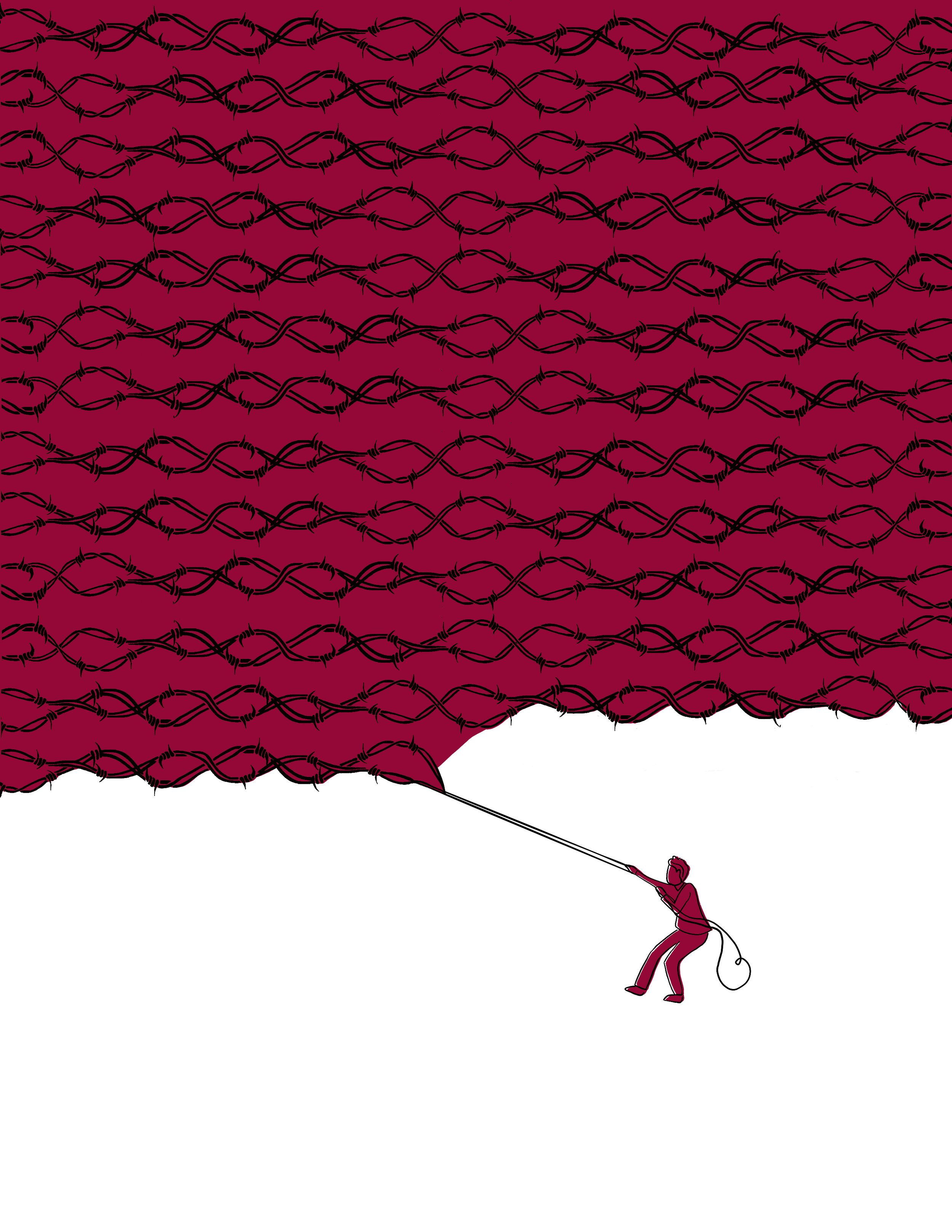
Abstract: Unraveling captures the exhaustion and enormity of confronting systems designed to hold people in place.
Keywords: Santa Ana; resistance; overwhelm
Citation
Afable, Gabriela. 2026. “Unraveling.” Semi-Structured (Washington, D.C.), On Ethnographic Witnessing: Student Encounters with Immigration Court, vol. 1 (3). https://doi.org/10.57912/34113315
Unraveling
Artist Statement
While court-watching, it was impossible not to witness how complex legal and bureaucratic processes shape the lives of individuals already navigating immense uncertainty. Through this imagery, the tangled wire becomes a visual representation of bureaucracy, confinement, and cycles that are difficult to escape. The small figure pulling against it emphasizes both the overwhelming scale of these systems and the determination required to challenge them.
About this issue
This article is part of On Ethnographic Witnessing: Student Encounters with Immigration Court, a special issue of Semi-Structured. This collection features the work of 22 student ethnographers, who offer insights, analysis, and experiences based on hundreds of hours in immigration courtrooms across the country over the last few years. Through their work in observation projects under the direction of scholar-activists Lauren Heidbrink, Amelia Frank-Vitale, and Rebecca Galemba, students gained critical training in ethnographic practice and a crash course in immigration law, especially in the disjunctures between law on the books and law in practice. Understanding that wider audiences would benefit from hearing and learning directly from their students, Heidbrink, Frank-Vitale, and Galemba approached Semi-Structured to steward this thoughtful, ambitious collection. We are honored to run this issue and invite readers to consider what student observers witnessed, felt, and learned in court and why ethnographic observations are important to broader publics.
Semi-Structured is the open-access journal from the Public Ethnography Lab. The journal is dedicated to showcasing ethnography as it unfolds in the world. This journal exists because we believe ethnographic work matters beyond the academy—that the insights generated through sustained engagement with communities, organizations, and institutions can and should inform decisions, shape practices, and drive meaningful change.