

At What Cost? A Damage-Control Photographer's Counter-Archive (Photo Essay)
Ankit Banerjee (he/they) is a researcher and contemporary artist with a formal background in Economics, Statistics, and an MA in Anthropology of Development at the University of Sussex. Working across analogue photography, sound, and text, his practice is grounded in durational fieldwork and sustained engagement with communities and institutions, investigating intimacy, domesticity, and systems of care as sites where power and tenderness coexist. His disenchantment with commercial image-making began early, sharpened by the political and ethical weight of who gets to be seen, how, and by whom. Trained across disciplines that resist easy consolidation, Ankit's practice attends to the social and relational structures that shape what we can know and what we are permitted to show.
Contact the author:
Email: ankit.bann@gmail.com
Website: http://www.ankitbanerjee.com/
AI Statement:
Author used Claude (Anthropic) during the writing process for the following limited purposes: correcting grammar, punctuation, tense consistency, and minor structural reorganising. The tool was not used for generative writing, paraphrasing, summarising, stylistic rewriting, or any addition of content, argument, or interpretation. All substantive writing, voice, and intellectual content remain the author's own.
Access a printable version of the article
Diptych 1:
(Left) Young women board a factory bus from their dormitories.
(Right) A weaver's wife welcomes visitors at her doorstep.
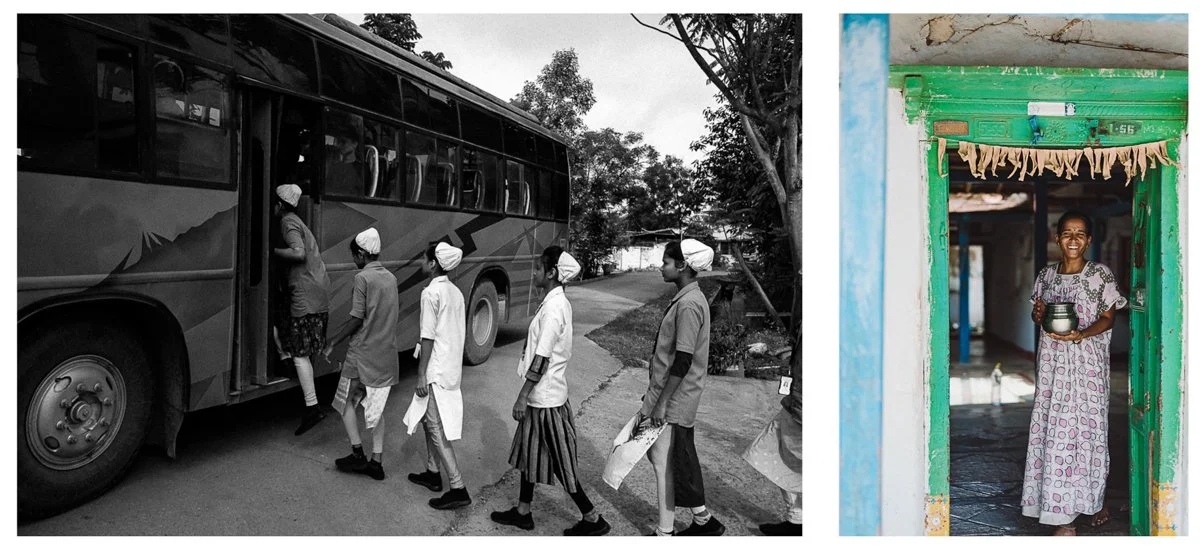
I found myself sitting in a lavish air-conditioned board meeting room of one of India's largest textile factories. The room was decorated with a range of modern textiles they produced, flaunting the global brands in their portfolio–away from the factory floor. I had been commissioned to photograph a company that employed nearly 200,000 people across production floors in India and central to the global fast fashion industry. Yet, the factory was also saturated by allegations of severe environmental and labour violations, which risked the factory's long-term partnerships with these brands.
Diptych 2:
(Left) Automated machines spin cotton on an industrial floor.
(Right) A weaver sits among her spinning tools.
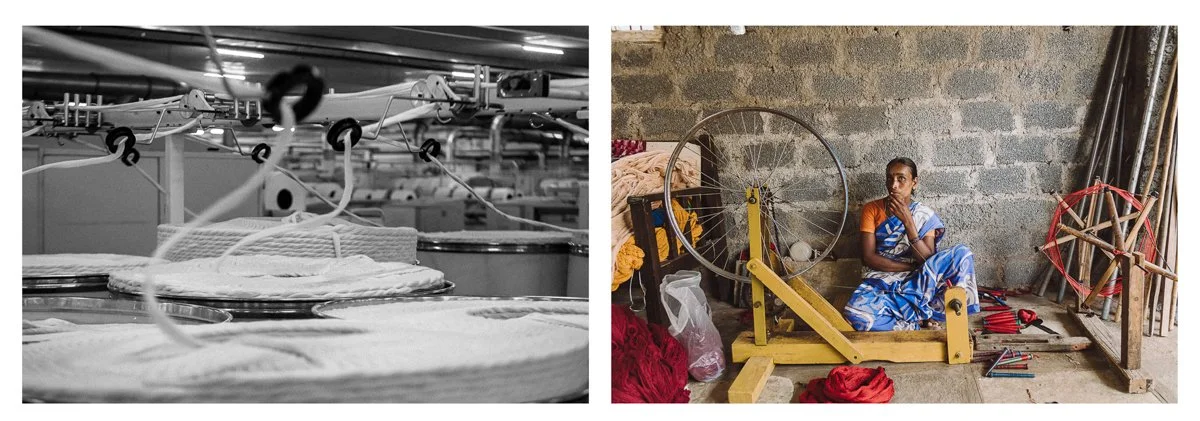
"What's the fuss with all the pollution allegations? Aren't we giving them a better life? Why can't they see that we're helping them stay in their villages?" The senior manager scoffed. For a moment, my mind drifted back seven years to the lanes of Pochampally in Telangana, where I was commissioned by an artisanal fashion label to document the lives of handloom weavers. Returning my gaze away from the window, it dawned upon me that I was being asked to participate in the very story the manager was telling. In plain terms, I was a damage-control photographer, commissioned to create visually appealing images that essentially presented the factory as an ethical, sustainable, and responsible space, as though the violations did not exist. By numbing my senses towards the deafening noise of the factory floor, the stench of the overflowing sewage treatment plant, and turning a blind eye to the evident reality, I was there to help the factory be seen. Through staged audits, choreographed visits, and sustainability reports, the factory was performing, while toxic chemical residue seeped into nearby lakes. Walking across the various processing units of the factory, from where the cotton is machine-spun into spools of thread, to where it is assembled as the warp and weft, I watched particulate lint float in the air. The whole experience was dystopian and nauseating.
Diptych 3: :
(Left) Dyed threads dry outside a weaver's home in Pochampally, Telangana.
(Right) Thousands of garment workers occupy an industrial factory floor.
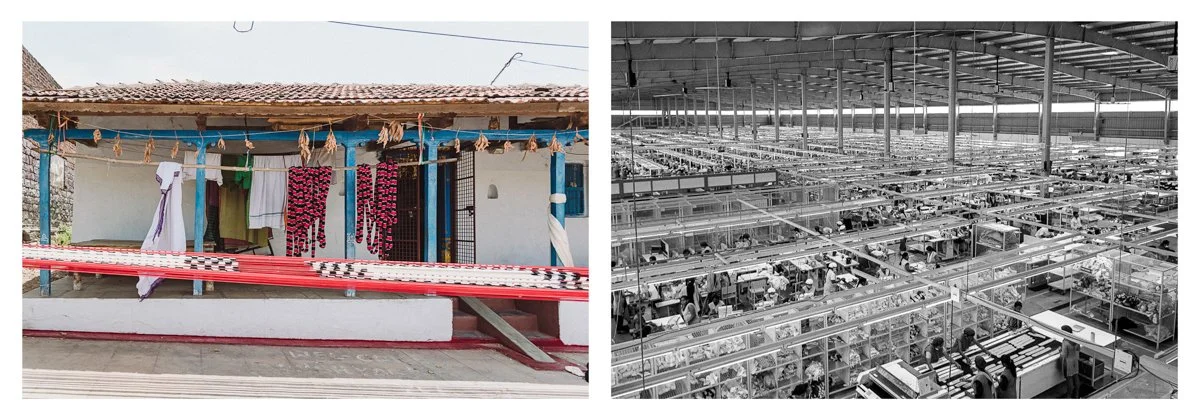
The memory resurfaced: in Pochampally, where they spun cotton by hand, and weavers dedicated an entire day to setting up the loom thread by thread before any weaving could begin. They specialised in the traditional craft of Ikat, a unique handwoven fabric. Weaving is central to their lives, and their homes were architecturally designed around the loom. Children played among balls of cotton to the rhythm of the shuttle moving through the shed of the handloom. In my conversations with the weavers, they spoke of their vocation as a cherished lineage, carried across generations, despite their low incomes, debt, and relentless pressures of cheap machine-made imitations. They knew their materials intimately; their hands carried a knowledge that preceded them, and would, if the economics permitted, outlast them. The same cotton moved through both worlds of the factory floor and the houses of Pochampally, but took on different meanings.
Diptych 4: :
(Left) Production scoreboards track output targets above workers on a garment factory floor.
(Right) Spools of thread stored on a shelf inside a weaver's home.
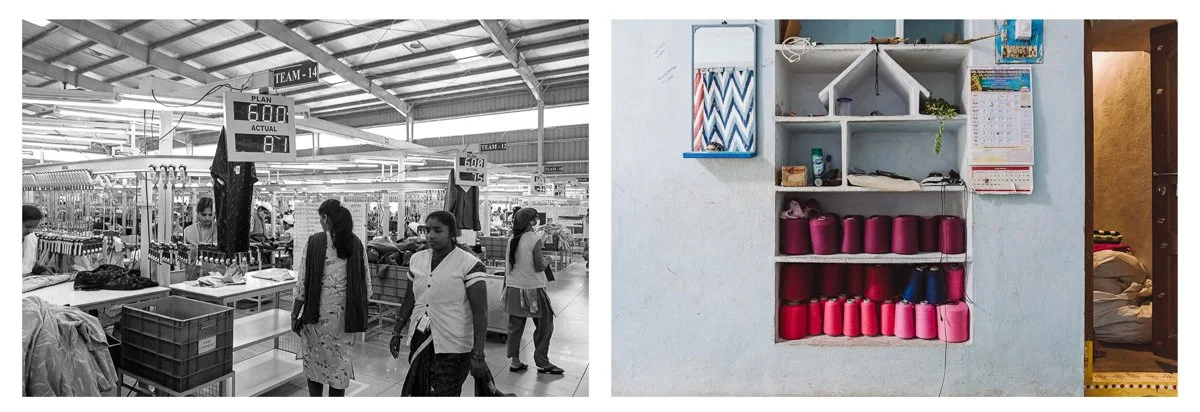
“Aren't we giving them a better life?” The factory manager's language of benevolence troubled me as I composed my frames and made photographs for my client. I thought that while this did not align with my politics, the camera was a tool that enabled me to enter contrasting worlds that I would otherwise not be exposed to. Overstimulated by the sheer scale and volume of the machinery, I too was a part of what Ferguson identifies as the antipolitics machine, where the structural violence is depoliticised and rendered as a technical problem of managing perceptions rather than a political question of who bears the cost (Ferguson, 1990).
Photographs are not transparent windows onto reality, but active agents in the production of meaning, shaped by the material and social context of their making. I was forced to ask: how much of our work sustains the inequalities we aim to resist? Reflexivity — the familiar shelter of a critical practitioner — often offered awareness, but not absolution. Inhabiting both sides of this conflicting terrain, and having access inside this megafactory, I produced two sets of images: a polished set for the client, and a counter-archive that documented the harsh realities. At the moment, the objective was to simply keep a record of what the commission was designed to hide. Yet, with every step I took on the factory floor, I was negotiating my rage towards the exploitative system while the memories of the families in Pochampally with whom I shared meals and laughter kept me grounded. While the counter-archive existed, I knew the work was far from done. Leaning into this tendency of slipping into thoughts of the handloom weavers, I knew I needed to bring the stark dissonances between the two worlds — the production processes, economic impacts, and cultural approaches — to viewers.
Diptych 5: :
(Right) A weaver ties threads for Ikat dyeing at his home in Pochampally.
(Left) Workers clean a denim dye runoff pit by hand at the factory.
Both bodies carry dye; only one carries knowledge.
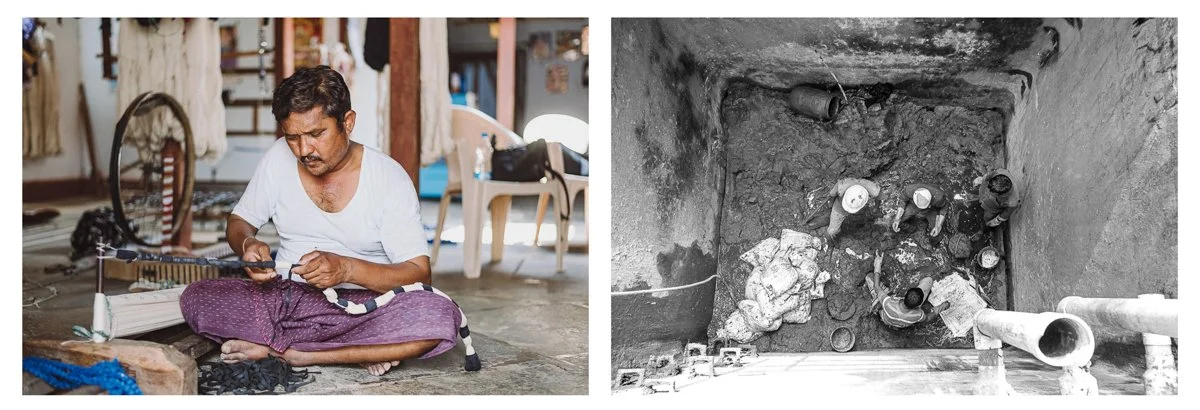
When we place two images side by side, we create a diptych, which asks the viewer to read them against or along each other. I decided to produce a series of black-and-white and colour diptychs depicting these opposite worlds. But as the pairings took shape, I realised the diptychs were doing something more than merely comparing — they were making an argument. Colour held the embodied knowledge, the cultural inheritance, and the texture of life organised around craft. Black and white depicted extraction, speed, and the monstrosity of mass production.
Diptych 6:
(Left) An automated robotic storage unit towers inside the factory.
(Right) Looms, thread, and tools occupy the interior of a weaver's home
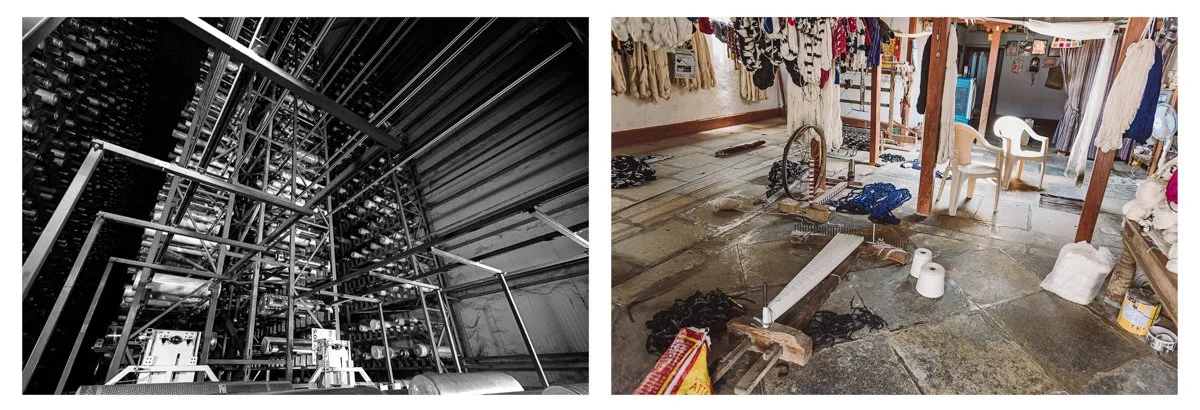
Furthermore, the pairings revealed that one world is built on the displacement of the other. The handloom weavers in Pochampally and the garment factory workers are connected by a supply chain that extracts value from each, rendering them invisible in different ways. The weaver is absorbed into a heritage discourse that celebrates craft, yet leaves the craftsperson starving. The factory worker exists within an apparatus of fast fashion that is structurally designed to prevent their visibility.
Diptych 7:
(Left) A factory worker watches fabric roll through a machine on the night shift.
(Right) A child sleeps beside the family loom.
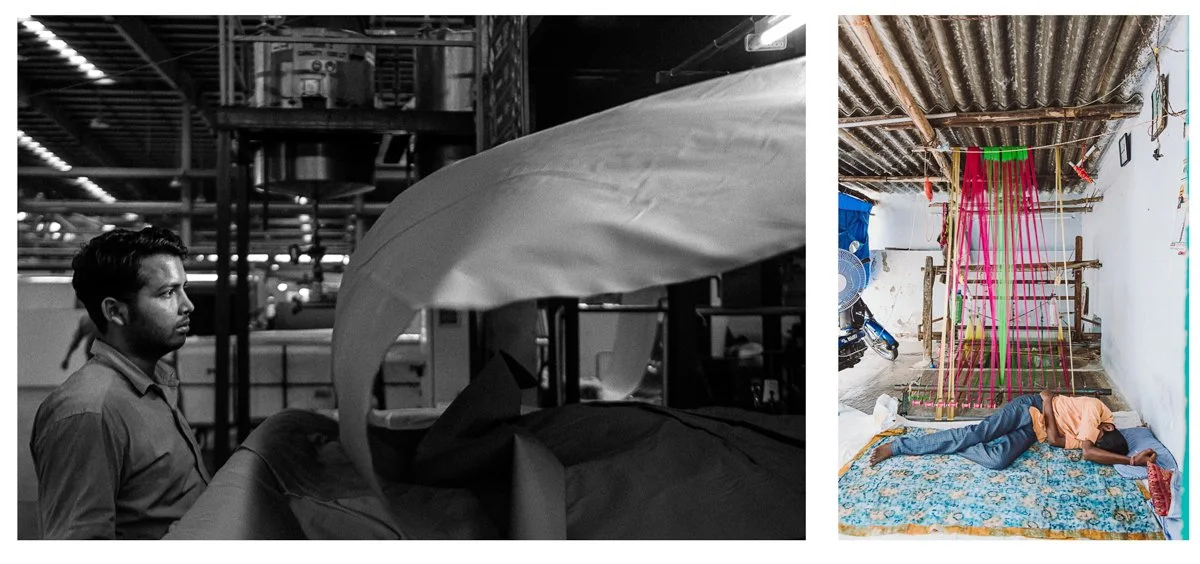
The weaver's livelihood is destroyed by the very same system that feeds the factory: cheap machine-made imitations undercut handloom produce, pushing the weaver's children to leave the loom for the factory floor, or to seek other menial work to make ends meet. Rising input costs, middleman exploitation, and the pull of cash wages — however exploitative — make social reproduction through inherited livelihood alone impossible (Carswell and De Neve, 2013; Gidwani and Ramamurthy, 2018).
Ariella Azoulay, in The Civil Contract of Photography, argued that the photographic encounter is a civil contract between three parties: the photographer, the subject, and the spectator (Azoulay, 2008). How the photograph is taken, who is involved, and where it is shown is how agency is negotiated. In today's saturated visual economy, the role of the viewer cannot be one of mere distancing and pity, where consumption becomes a mechanism of desensitisation and passive spectatorship of human suffering.
Diptych 8:
(Left) A weaver smiles at something beyond the frame, her charkha spinning in open air.
(Right) A worker faces away, absorbed into the scale of industrial machinery.
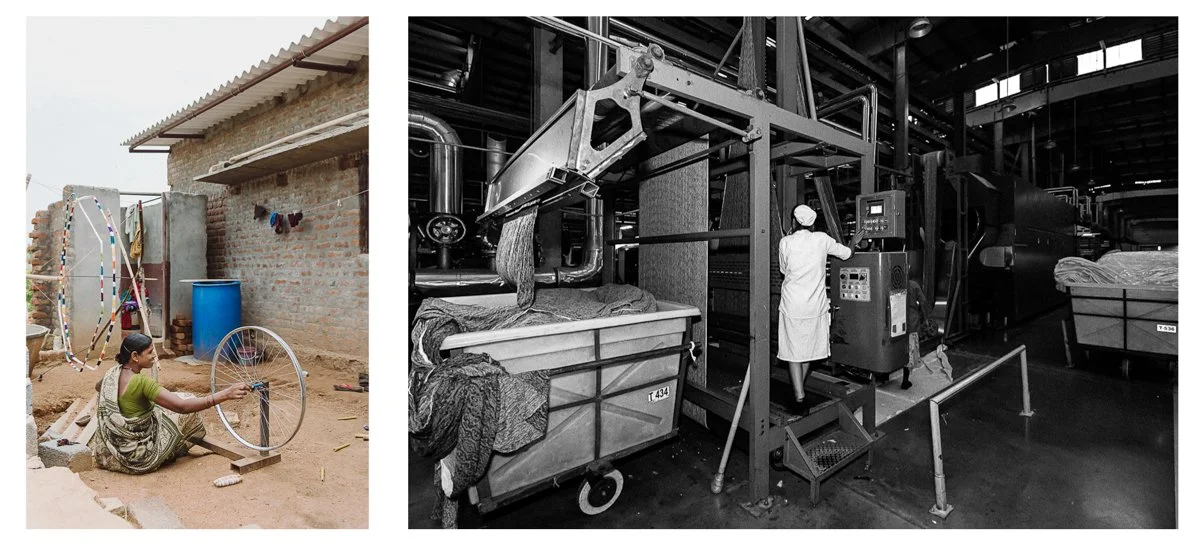
The diptych — emerging from my inner discomfort — became an ethical argument that provokes the toil and precarity gripping both sides of the labour. By surfacing the suppressed image over the commissioned one, and pairing it with images from the handloom village, I was able to navigate my complicity. Juxtaposing a consistent black-and-white and colour grammar constructed the conditions under which structural violence becomes legible. The diptych here is an ethnographic methodology, not merely a presentation format. In placing the two worlds side by side, I was refusing invisibility and transferring my ethical obligation of witnessing onto the viewer. My complicity on the factory floor became its own form of evidence.
Diptych 9:
(Left) Toxic chemical froth overflows from the factory's sewage treatment plant.
(Right) A weaver's wife moves through her home in Pochampally
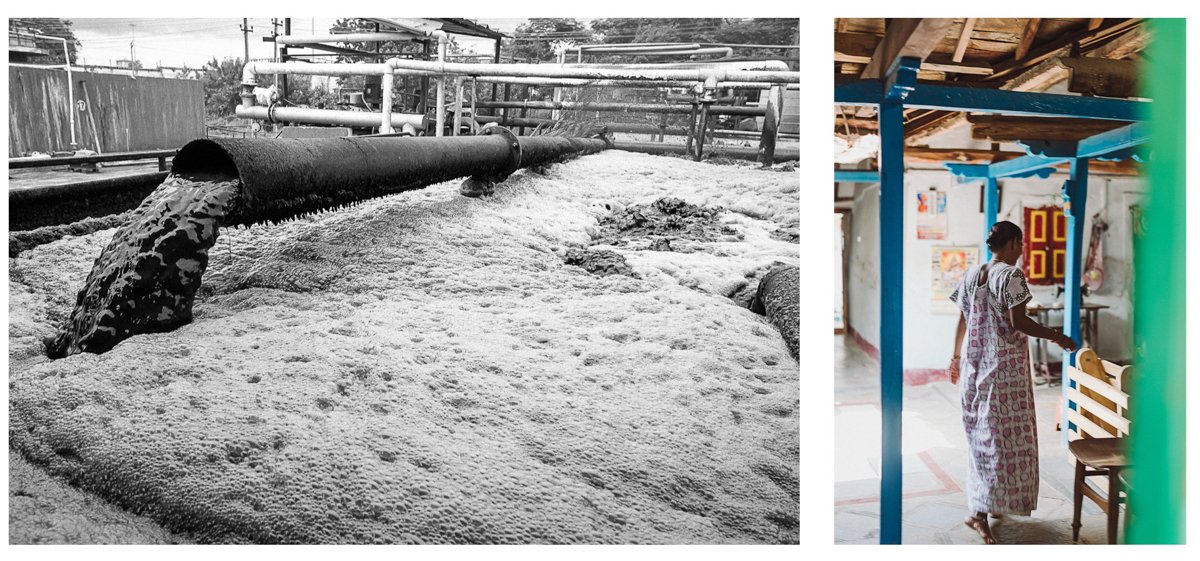
This series, ‘At What Cost? (2023), resides in a corner of my website and on my social media channels. Acting as a whistle-blower in plain sight, it sits awkwardly in a space that neither sparks controversy nor gathers dust. Whether it changes anything beyond the frame of the images is not something I can guarantee. To expose the systems, the structural conditions, and implicate them — that is what I insist on. Yet that insistence comes at the risk of jeopardising my already precarious career. Although my reach is limited and the neoliberal apparatus is vast, such acts of resistance, however small, can contribute to larger advocacy efforts that challenge oppressive systems. As Susan Sontag puts it, photography does not merely record the world — it organises how we see it (Sontag, 1977). Creating the counter-archive in the field, assembling the diptychs, and writing this essay are all incremental decisions that follow from that. This significantly risks future commissions. And yet in engaging in meaning-making with the wider public, can we, as practitioners, transcend the structures we inhabit, or will our efforts remain bound by the very constraints we seek to critique?
References
Azoulay, Ariella. The Civil Contract of Photography. New York: Zone Books, 2008.
Carswell, Grace, and Geert De Neve. "From Field to Factory: Tracing Transformations in Bonded Labour in the Tiruppur Region, Tamil Nadu." Economy and Society 42, no. 3 (2013): 430–54. https://doi.org/10.1080/03085147.2013.772757.
Ferguson, James. The Anti-Politics Machine: Development, Depoliticization, and Bureaucratic Power in Lesotho. Cambridge: Cambridge University Press, 1990.
Gidwani, Vinay, and Priti Ramamurthy. "Agrarian Questions of Labor in Urban India: Middle Migrants, Translocal Householding and the Intersectional Politics of Social Reproduction." The Journal of Peasant Studies 45, no. 5–6 (2018): 994–1017. https://doi.org/10.1080/03066150.2018.1503172.
Sontag, Susan. On Photography. New York: Farrar, Straus and Giroux, 1977.
Further Reading
Bogre, Michelle. Photography as Activism: Images for Social Change. Amsterdam: Focal Press, 2012.
Edwards, Elizabeth. Raw Histories: Photographs, Anthropology and Museums. Oxford: Berg, 2001.
Grimshaw, Anna, and Amanda Ravetz, eds. Visualizing Anthropology: Experimenting with Image-Based Ethnography.Bristol: Intellect Books, 2005.
Ngai, Pun. Made in China: Women Factory Workers in a Global Workplace. Durham: Duke University Press, 2005.
Pinney, Christopher. Photography and Anthropology. London: Reaktion Books, 2011.
Scheper-Hughes, Nancy. "The Primacy of the Ethical: Propositions for a Militant Anthropology." Current Anthropology36, no. 3 (1995): 409–40.
Twomey, Christina. "Framing Atrocity: Photography and Humanitarianism." History of Photography 36, no. 3 (2012): 255–64. https://doi.org/10.1080/03087298.2012.669933.